


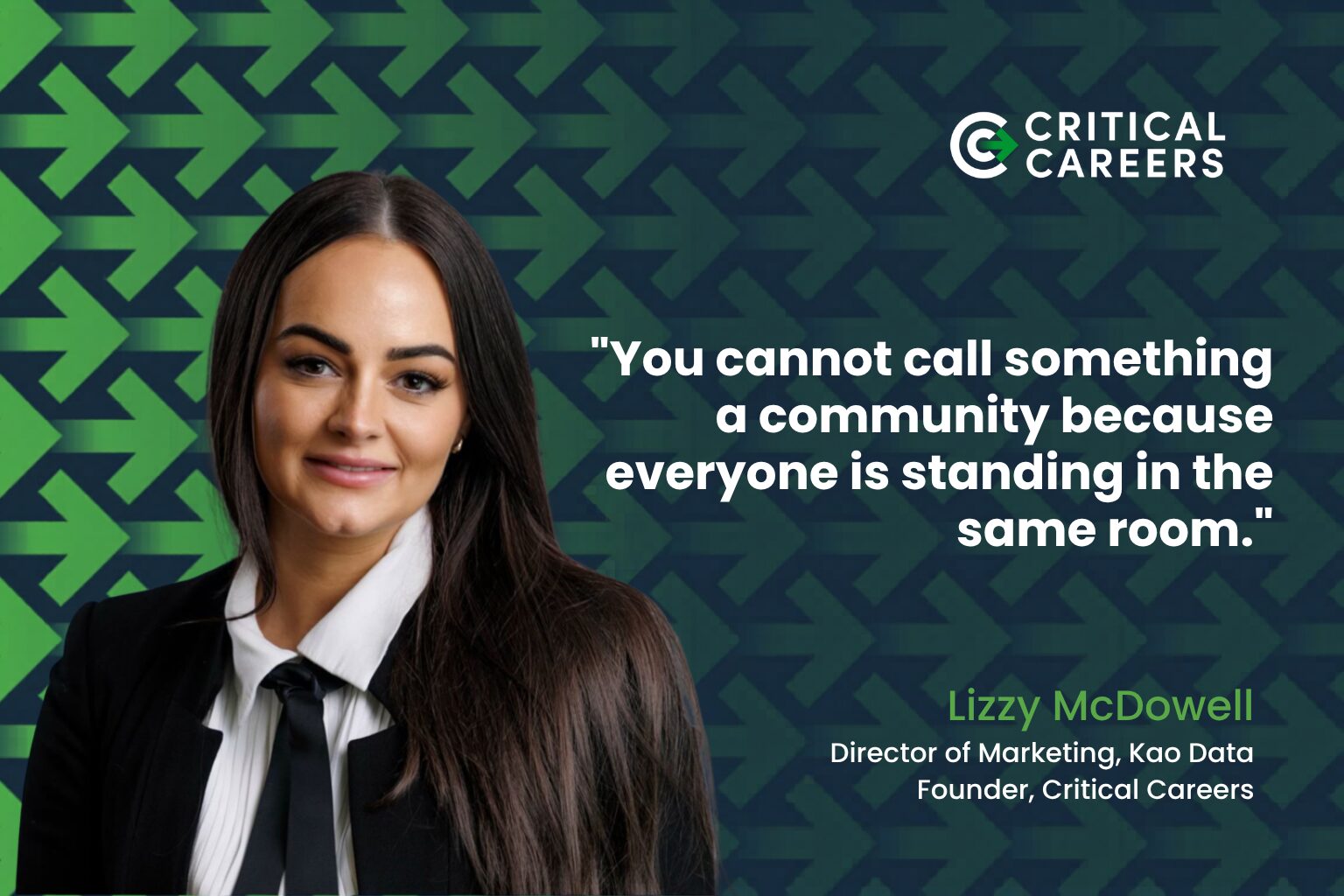
Community does not happen simply because people occupy the same space, argues Lizzy McDowell, Director of Marketing at Kao Data, as she explores the belief and responsibility that turn connection into belonging.
There is a word we use a lot in this industry without always stopping to ask what it means: community. We talk about the digital infrastructure community, the women in our community and the communities that live alongside the sites we build. It is one of those words that sounds warm and obvious, and yet the more I sit with it, the more I think we underuse its real meaning.
For me, community begins with a sense of belonging. Being in the same place at the same time has very little to do with it. What matters is a shared commitment to preserving, building and enhancing something we all care about. There is almost an unwritten contract within that. Everyone has a role to play, and everyone quietly agrees to pull their weight so that what we have becomes better, rather than simply bigger.
A community is built on shared belief
Think about why a row of houses on a street becomes a community. It has very little to do with the bricks or the postcodes. What binds those neighbours together is a shared interest in making the place they live in as good as it can be. Take that shared interest away and you are left with people who happen to live near one another.
The same is true of our industry. You cannot call something a community simply because everyone is standing in the same room. A community is a group of people who have bought into a greater good.
That distinction matters because it shapes how we approach two very different parts of what we do at Kao Data.
Two sides of the same coin
The first is women in digital infrastructure. A few years ago, I am not sure I would have described what we had as a community. Today, it feels completely different. I can arrive at an event and meet women I have never spoken to before, and there is an instant connection because we are part of the same industry and recognise something of ourselves in one another.
That connection has grown into something with real responsibility attached to it. We feel a collective duty to preserve what we have built, to keep shaping it and to make room for the women who will come next.
The second is the community impact of the sites we develop. You cannot build digital infrastructure of any scale without the people who live around it. Engaging local communities, listening to them and helping them understand what a project will bring goes far beyond ticking a box. It is fundamental to whether the ecosystem gets built at all.
The mindset behind it is exactly the one I have just described. You bring people together around a shared interest, look after what already exists and invest in the future.
That is why I have come to think of community as a philosophy rather than a label. It is an attitude you carry with you, whether you are championing women in the sector or sitting down with residents near a new build. Once you have bought into it, it tends to stick with you wherever you go.
Community does not just happen
Communities are not accidents. They come together when enough people share a common objective and decide to make things better. My part in that, as a marketer, is really about communication: telling the story of what exists in the world we work in, both internally at Kao Data and externally across the sector.
Marketing, at its heart, is storytelling, and Critical Careers exists to evidence this community and the women within it. The more we show what is already here, the more we encourage others to step into it.
That is also why collaboration matters so much. Earlier this month, Critical Careers teamed up with the Women’s Tech Forum in London to bring two communities together and, in doing so, build a bigger one. We recorded a podcast with a genuinely brilliant line-up, including Ilona Koprowska from Meta, Jess Simmons from Google and Simmi Bryan from Megaport, and rounded off the evening with drinks for women and allies.
Watching that room fill up said more about the health of this community than any figure ever could.
Because that, in the end, is what community asks of all of us: look after what we have and nurture what comes next. You cannot have one without the other, and you cannot have either without people who genuinely want to make things better.
See you next month.