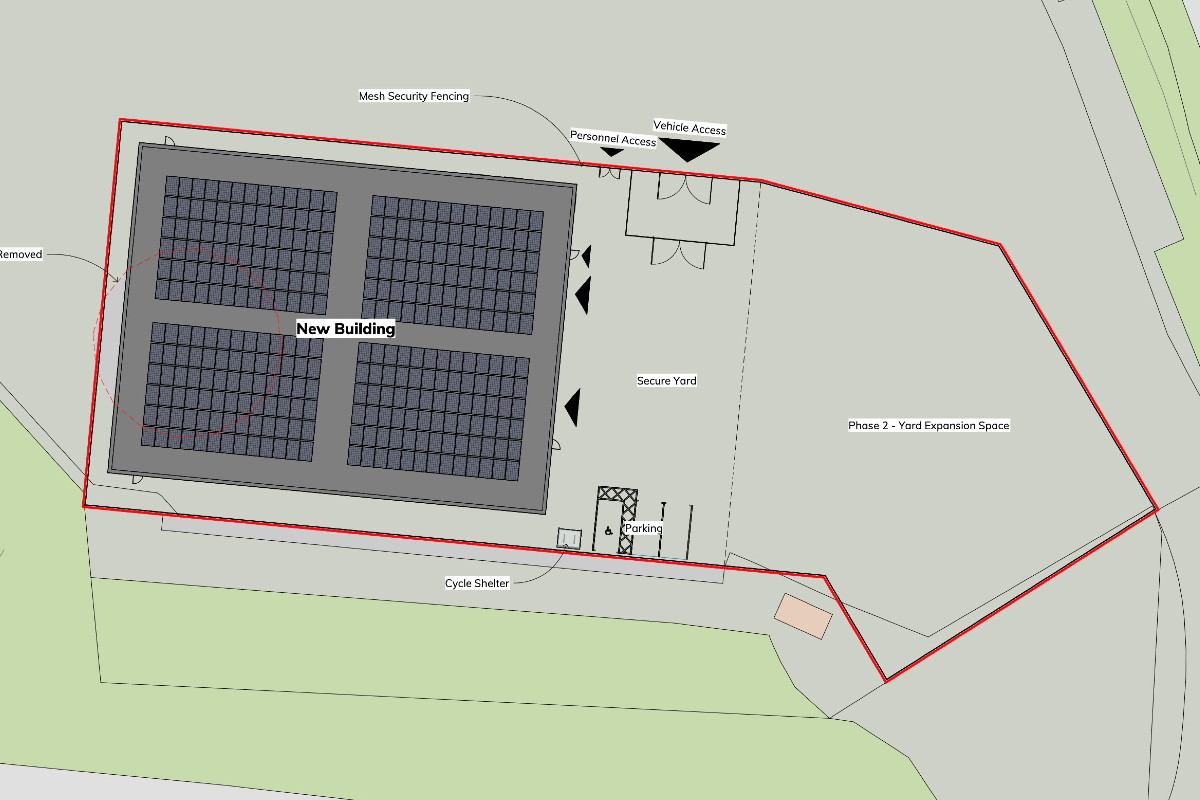
Canterbury City Council has approved plans for a new data centre that will use electricity generated from landfill gas.
The facility, which was proposed by Era4 back in November 2025, previously came before the council’s planning committee back in July, but the decision was deferred to a later date to give time for a formal site visit. In the end, the councillors decided to take the planning officer’s recommendation and approve the data centre.
The development will occupy land previously used for composting operations at an existing landfill and waste management site operated by Valencia Waste Management. That former life is actually useful too – as it’ll be key to providing electricity to the site.
Rather than relying entirely on a conventional grid connection, Era4 plans to draw power through a private-wire connection to the neighbouring Valencia Energy Centre, which generates electricity using methane captured from the landfill.
According to planning documents, the facility could consume approximately 140MWh of electricity per day at full utilisation, equivalent to an average continuous demand of around 5.8MW.
Planning officers noted that this would fall within the energy centre’s average daily generation, so it shouldn’t have an increased burden on the local electricity grid.
Part of a wider landfill gas strategy
The data centre isn’t just relying on the Valencia Energy Centre, however. It will also incorporate rooftop solar panels and a closed-loop liquid cooling system, supplemented by adiabatic cooling. That should give it a lower environmental footprint compared to some other projects being built around the world.
It won’t be the only one of its kind for Era4 either as the company, previously known as Carbon3.AI, announced a partnership with Valencia Waste Management in October 2025 to develop landfill gas-powered data centres at eight locations across the UK.
The arrangement is one of several alternative electricity supply models being explored by developers as grid capacity constraints complicate new data centre projects.
A proposed 72MW data centre near Reading is planning to use natural gas fuel cells while awaiting additional grid capacity, while Kao Data has agreed to procure electricity from a planned 40MW solar farm through a private-wire connection at its Harlow campus.
The Canterbury project differs by using generation associated with an existing landfill operation, although the long-term reliability of that supply will be an important consideration.
Landfill gas production can decline as organic waste decomposes, potentially affecting how much electricity can be generated over the lifetime of the data centre. While capturing methane for electricity generation can reduce emissions that would otherwise escape into the atmosphere, burning the gas still produces carbon dioxide and other pollutants.
Whether the solution ultimately proves successful will likely become apparent when the new data centre becomes operational. When exactly that will be has yet to be confirmed, however.