

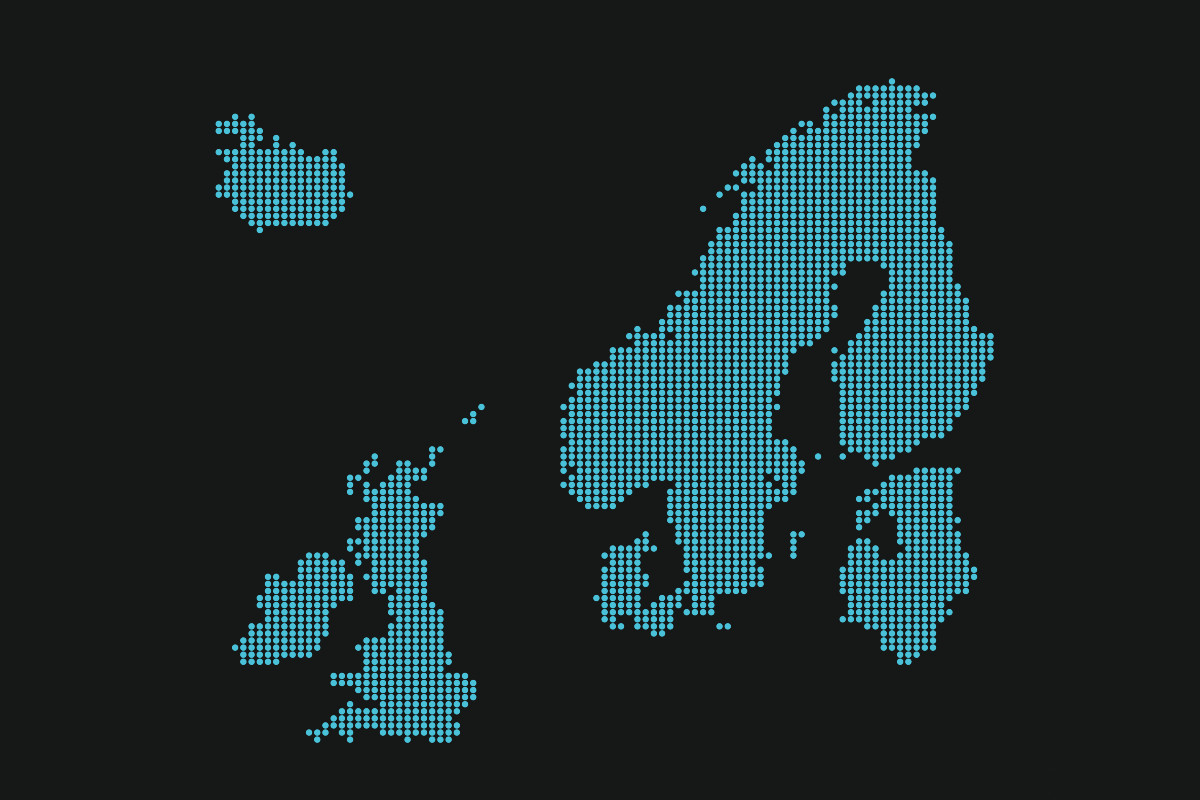
As AI pushes data centre power requirements to unprecedented levels, the factors determining where infrastructure is built are changing. Eva Sóley Guðbjörnsdóttir, CFO and Deputy CEO at atNorth, explains why Europe’s centre of gravity is beginning to shift northwards.
We all have a mental image of what a data centre looks like. For most of us, it is a large, warehouse-like building stacked with racks and racks of servers, supported by a wide range of auxiliary systems to keep them operating. But it was not always that way. The design, size and capabilities of data centres have evolved in response to changing demand, usage and physical location. Looking back over the past three decades, we can see how different demands and constraints have shaped these shifts, and how they continue to guide how data centres are designed, built and operated today and tomorrow.
Keep out: Computers at work
Prior to the internet age, most enterprises kept their mainframes, and latterly servers, in dedicated computer rooms. These were essentially specialised vaults that prioritised physical security, power and cooling stability. Think of the computer rooms in movies like Dr No, Wargames or Tron. Initially, there was no connectivity, but from 1993, as World Wide Web protocols began to open the power of the internet to enterprises and consumers, interconnection to outside resources became the first key trend in the development of true data centres as we know them today.
Only connect
Proximity to networks and interconnection became key drivers of what became known first as ‘Telco Hotels’ and then as ‘Carrier Neutral’ facilities, as telecoms companies created hubs for emerging internet service providers to interconnect to multiple global networks. These were the first generation of modern data centres, emerging in the late 1990s. Today, much of the focus is on training AI and access to power is key, but in this decade it was all about interconnect for network operators, enterprises and service providers. The main design priorities were to maximise communications capacity, minimise latency and provide redundancy across multiple carriers.
This design focus, combined with the nature of early corporate customers in centres of international business and finance, created the foundations of today’s data concentration in Frankfurt, London, Amsterdam, Paris and Dublin (the so-called ‘FLAP-D’ markets). A high density of networks and proximity to key customers favoured sites in urban environments. Although this model worked initially, its limitations were apparent from the beginning, as rapid growth would quickly run into constraints on available space and power in urban settings. By today’s standards, early facilities were relatively compact, constrained by their location, often in pre-existing buildings, and had limited power capacity in the range of 5–20 MW. They were not especially efficient; power usage effectiveness (PUE) ratios were often higher than 2.0 and, according to the European Commission’s own research, public sector data centres had PUEs in excess of 5.
Real estate
The shift to the cloud from the early 2010s changed the dynamic. Rapid growth in public cloud as a lever for digital transformation saw demand for data centres accelerate. The so-called hyperscalers – AWS, Microsoft, Google and Meta – started to develop much larger data centres. There was also a fundamental shift in design, from essentially network hubs to digital factories with significant compute and storage capabilities.
With often tens of thousands of servers, plus associated memory and networking infrastructure, in each data centre, standardisation and modularity became critical to design. Pioneering operators have used these flexible yet repeatable designs to move quickly and create data centres that can grow with demand. The ability to swap out, reconfigure and expand sites became an important design consideration. Whilst still close to customer populations, these sites were often too large to locate in city centres and shifted to the outskirts, 10–20 km from the centre, but still close to major fibre routes and often airports.
As power demand grew to over 100 MW, the availability, sustainability and price of the power needed to run all those servers and auxiliary systems became a significant concern. New, purpose-built sites could incorporate innovations in cooling and functional layouts that led to improved energy efficiency. Between 2007 and 2025, the average PUE fell from 2.5 to 1.36 in Europe.
Power proximity
Yet hyperscale cloud campuses still clustered around major metros to fulfil local demand. The crunch came in the early 2020s. In many FLAP-D markets, land and power constraints began to impact the speed and number of data centre developments permitted. Some markets, including Amsterdam and Dublin, saw moratoriums on new data centre building. Concern among regulators and the public over not only energy but also water consumption, plus spiralling land costs, meant that urban proximity and density of demand, once key to data centre design, became significant constraints. The logic of ‘build where the demand is’ that had driven early waves of data centre building began to break down. In the same decade, many Nordic countries began to capitalise on investments in renewable energy, as well as the availability of land and supportive business and political environments, to attract a new wave of data centre development.
Artificial intelligence is now accelerating that shift. Unlike traditional cloud workloads, which distribute across many small applications, AI training concentrates compute into vast, tightly coupled clusters. Bringing thousands, and sometimes hundreds of thousands, of high-power processors into close proximity presents new design challenges. Some data centres are reimagining their internal layout as hot-aisle/cold-aisle airflow is replaced with direct-to-chip liquid cooling. As rack densities have increased by an order of magnitude, from 5–10 kW to as much as 100 kW per rack, innovative ways to distribute power internally and more efficiently are needed. The result is a new class of facility: the AI data centre, or ‘megafactory’. These sites are defined less by floor space than by power. Individual campuses are now being designed for 100–500 MW of capacity, with some future clusters targeting gigawatt-scale deployments.
Europe’s AI centre of gravity
Data centres are becoming energy-intensive production facilities for the digital economy. Energy ‘gravity’ is increasingly competing with data gravity: today, it can be easier, faster and more sustainable to bring data and compute to where there is abundant power. It is in this context that the Nordics – Sweden, Finland, Norway and Denmark – are emerging as an increasingly important location for Europe’s data centre infrastructure.
Compared with many FLAP-D markets, the Nordics offer abundant, relatively low-cost and predominantly renewable energy. In many cases, electricity systems are already heavily decarbonised, with renewable shares far exceeding those of Western European hubs. This abundance can also translate into lower prices – the Nordic average is below €40/MWh, compared with a European average above €100/MWh and €117/MWh in the UK.
Just as importantly, the region offers space: low population density, once a hurdle, can now be an advantage. AI training does not necessarily need a local market and so can take place where energy and land are available without adding the same pressure to densely populated areas. AI data centres can also be located close to generation capacity, reducing demand for new grid infrastructure in already congested areas. In many cases, data centres utilise brownfield sites left by previous heavy industry, such as paper mills, and are even using urban locations vacated by earlier industrial plants.
What is emerging is not a simple relocation of infrastructure, but a layering of roles, design and location. The FLAP-D markets will continue to be important for connectivity and low-latency financial services and related workloads, but their growth will be constrained by power and space. At the same time, a growing share of new large-scale developments and AI-focused investments is being directed northwards, where developers can access a different mix of land and power. The Nordics are predicted to grow their data centre footprint twice as fast as FLAP-D over the next five years.
As data centre design has moved from prioritising connectivity to proximity, then from space to power availability, the Nordics are well positioned to play a significant role in the future of Europe’s AI infrastructure. Data centres must be considered not only as consumers of power, but as active participants in the energy ecosystem. As AI demand accelerates, the question is no longer just where to build, but how to build responsibly at scale.