
As conventional hard drive technology reaches its physical limits, Dean Edwards, General Manager Engineering & Technical Support at Toshiba Electronics Europe, explores how MAMR and HAMR could take HDD capacities to 50TB, 100TB and potentially beyond.
In recent years, hard disk drive (HDD) storage capacities have typically increased by around 2TB per year. For this trend to continue, new technologies such as microwave-assisted magnetic recording (MAMR) and heat-assisted magnetic recording (HAMR) are required, as conventional perpendicular magnetic recording (PMR) has now reached its limits. But what do MAMR and HAMR do differently, and what capacities will be possible in the coming years?
HDDs remain essential in large storage infrastructures because they continue to offer a cost-effective means of storing large volumes of data while allowing direct access. Advances in HDD technology have consistently increased drive capacities.
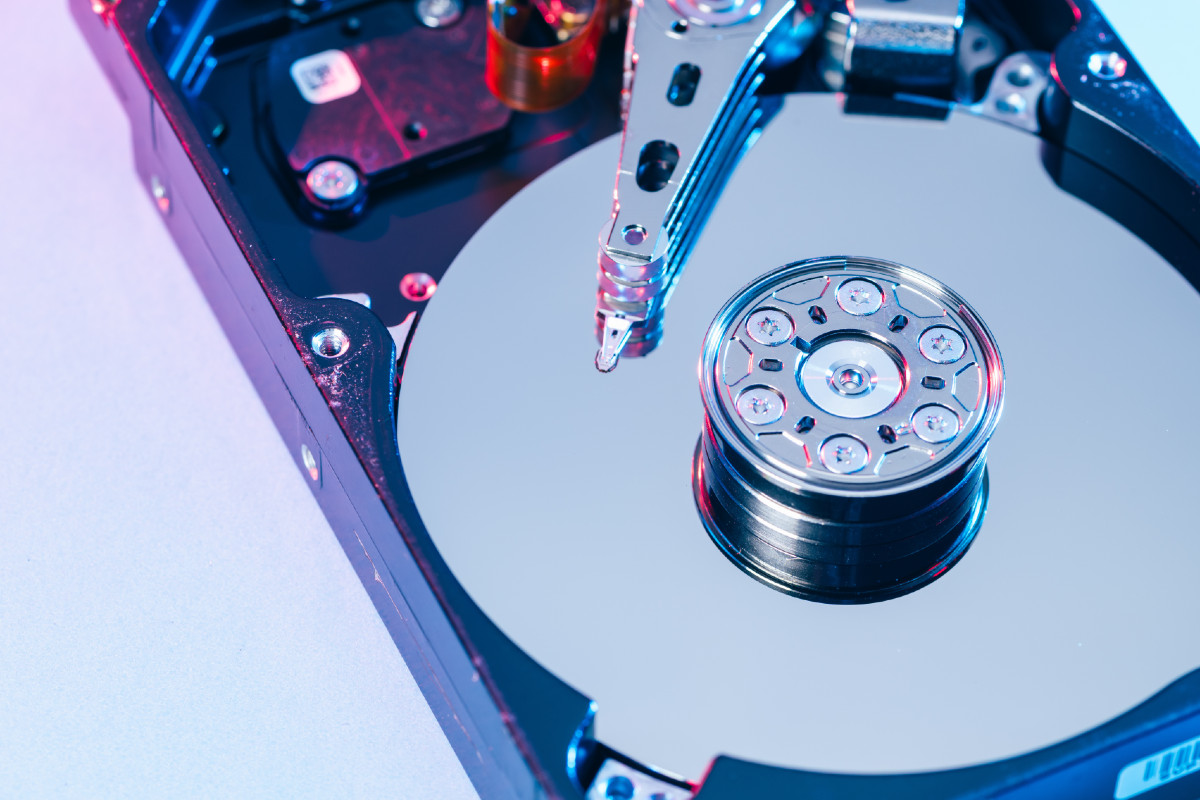
To achieve higher capacities, HDD manufacturers essentially have two options: fitting more disks into the 3.5-inch form factor or increasing the data density on the magnetic platters. Around ten years ago, helium-filled drives and thinner disks made it possible to install nine instead of eight platters. Later, a smaller circuit board underneath the drive housing – no longer extending beneath the platter stack – enabled the addition of another disk.
The disks have since become even thinner, measuring only 0.55mm instead of the previous 0.635mm, allowing 11 platters to fit into a single drive. There have also been demonstrations of a design with 12 disks. The key innovation here is the transition from aluminium substrates to glass as the base material for the platters, since glass deforms less during coating and rotation. This allows thinner disks to remain mechanically stable and rotate with minimal variation in the rotational plane.
New coatings provide greater bit stability
When increasing the data density on disks, the recording method itself plays the decisive role. Over the past 20 years, this has been perpendicular magnetic recording (PMR) – so named because, unlike the previously used longitudinal magnetic recording (LMR), the bits are aligned vertically rather than horizontally. The increasingly fine grain structure of the magnetic coating on the disks has made it possible to place individual bits and data tracks ever closer together, thereby storing more data on the same surface area. However, physics imposes limits that have now effectively been reached: if the grain structure were made even smaller, the bits would no longer remain sufficiently stable and could more easily ‘flip’ as the drive heats up during operation.
This can be avoided through new coating materials with higher coercivity than the iron-cobalt alloys previously used. The higher the coercivity, the better the coating retains its magnetisation and the more stable the bits become.
Aligning the bits during write operations on these new surfaces requires more magnetic energy than before – more than HDD write heads can provide without increasing their size. Larger write heads are undesirable, however, because they would increase the spacing between the disks again. HDD manufacturers have therefore developed new technologies such as MAMR and HAMR, both of which use iron-platinum coatings with higher coercivity and temporarily alter their magnetic properties so that writing can be achieved using less magnetic energy.
Not all MAMR is the same
Strictly speaking, MAMR exists in two variants: flux-controlled MAMR (FC-MAMR) and microwave-assisted switching MAMR (MAS-MAMR). FC-MAMR has already been used in HDDs for some time and concentrates the magnetic flux through a microwave field generated by a spin torque oscillator. This allows bits to be written more densely, although two read elements are required in the read/write head to improve the signal-to-noise ratio (SNR) and reliably read the bits back.
Since FC-MAMR does not directly affect the coating material itself, the technology works with existing coatings but provides only comparatively modest capacity increases. Greater medium-term gains are expected from MAS-MAMR, which actively interacts with the coating.
In MAS-MAMR, a dual spin torque oscillator within the write gap of the read/write head generates a stronger microwave field that specifically excites the target area within the iron-platinum coating. When oscillating at the correct frequency, only a small amount of magnetic energy is required to align the grain structure and write a bit. Once the oscillator is switched off, the material stops oscillating and the bit remains stable.
Apart from the precise oscillator circuitry, the technology itself is relatively straightforward and places little stress on the material. It can also be combined with shingled magnetic recording (SMR), which is expected to enable capacities of 32 to 33TB per drive in the next HDD generation using eleven disks. The following generation, featuring twelve disks and further improvements to MAMR, is expected to achieve around 40TB.
Although SMR has previously been criticised due to fluctuating write performance, larger caches and improved caching algorithms have helped address some of these concerns. However, for environments with heavy write workloads or strict requirements for constant, predictable performance, models without SMR are likely to remain available – albeit with somewhat lower capacities.
Heat increases material requirements in HAMR
Because the spin torque oscillator must fit into the write gap, it must be extremely small. This limits its performance, making capacity increases far beyond 40TB unlikely with MAMR. In the long term, HAMR offers greater potential.
With HAMR, a laser diode is positioned above the read/write head. Its laser beam is guided via an optical waveguide into a near-field transducer (NFT), which focuses the energy precisely onto the area to be written. This area is briefly heated to the material’s Curie temperature, well above 400°C, causing it to largely lose its magnetic properties and allowing the grain structure to be aligned using only a weak magnetic field. It then cools rapidly, stabilising the magnetisation.
Technically, HAMR is more challenging than MAMR because laser diode performance degrades over time and the materials must withstand significantly higher thermal stress. Manufacturers have therefore had to address questions around durability and reliability as part of HAMR development. For enterprise drives, the target remains comparable reliability and workload characteristics to previous HDD generations, including mean time to failure (MTTF) figures of around 2.5 million hours and workloads of up to 550TB per year. Power consumption increases only minimally due to the laser diode, while the higher storage capacities can reduce the watts-per-terabyte ratio compared with lower-capacity models.
The next HDD generations based on HAMR are expected to initially deliver capacities of around 45TB and later 55TB per drive. For twelve-disk models, one challenge is that the laser diode mounted above the read/write head makes the assembly slightly taller, meaning it would no longer fit between the magnetic platters using the current design. However, this issue could be addressed through a small opening in the head suspension assembly.
The ultimate capacities achievable with HAMR are not yet entirely clear – some experts anticipate 100TB or more per drive. Even if HAMR does not reach such levels, HDD manufacturers are already researching successor technologies that make more efficient use of platter surfaces, for example through uniformly aligned grain structures or isolated magnetic ‘dots’.
Conclusion
With up to 12 disks and advanced recording technologies such as MAMR and HAMR, HDDs are expected to continue offering steadily increasing capacities for many years while retaining an important role in large-scale storage infrastructure. Both MAMR and HAMR rely on new coating materials to achieve greater bit and track densities, but both also temporarily alter the magnetic properties of these coatings during write operations to reduce the magnetic energy required.