

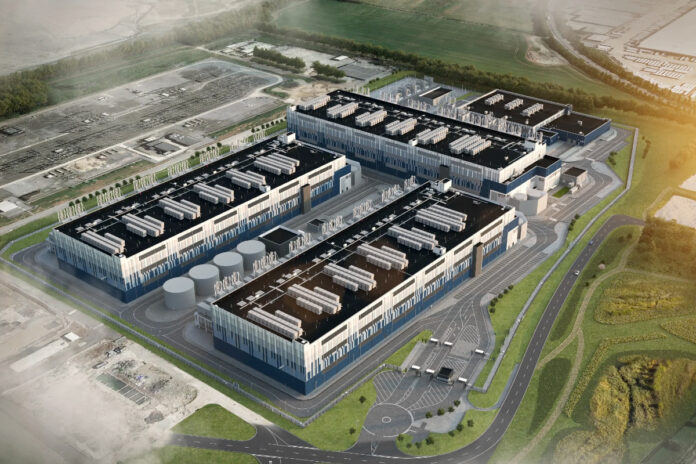
Amazon is awaiting a planning decision on detailed proposals for a four-building data centre development at the former Didcot A Power Station site in Oxfordshire.
This isn’t the first time that plans for a data centre at Didcot A have gone before the Vale of White Horse District Council. An earlier outline planning application was filed under a development company in July 2021 and subsequently approved, with the latest submission covering the next level of detail as Amazon confirms its involvement with the project and looks to move the project forward.
If granted, the scheme would add Didcot A to the growing list of former power generation sites being repurposed for data infrastructure – a trend being driven as much by electricity as it is by available land.
Amazon has not publicly set out a construction timeline, but the development sits within a wider push by the company to expand its UK data centre footprint. Amazon has previously said it will invest £8 billion between 2024 and 2028 to build, operate and maintain data centres in the UK, with Didcot expected to form a notable part of that programme alongside another proposed site in Iver, Buckinghamshire.
For local planners, the immediate question is whether the detailed plans align with the parameters set by the earlier outline consent and whether the development is acceptable in its proposed form for the area surrounding the former station. There has already been increasing scrutiny on the data centre sector from environmentalists – but the UK Government has already showcased its willingness to get involved if projects are rejected.
The Vale of White Horse District Council is expected to make a formal planning decision by January 27, 2026.
Power station sites are becoming the obvious target
Didcot A is far from unique in attracting data centre interest. Developers are increasingly looking to former power stations as potential campuses, with a number of high-profile projects either in planning or being actively discussed around the country.
Recent examples include proposals for a data centre at the former Cottam coal-fired power station in Nottinghamshire, Drax’s plans for a 100MW data centre at its Selby power station, and Rushcliffe Borough Council’s ambition to bring a data centre to the site of the former Ratcliffe on Soar Power Station.
The common thread is obvious: power.
In a market where grid connections can take years to secure and reinforcement works can be eye-wateringly expensive, old generation sites offer something increasingly rare – existing high-capacity connections that were originally designed to move large amounts of electricity.
That advantage can significantly reduce one of the biggest barriers facing new data centre projects: getting enough power to site, and getting it quickly enough to match demand.
Didcot A, which previously supplied electricity to the National Grid, is therefore an attractive proposition for hyperscale developers seeking locations capable of supporting energy-hungry facilities without being stranded at the back of the connections queue.