

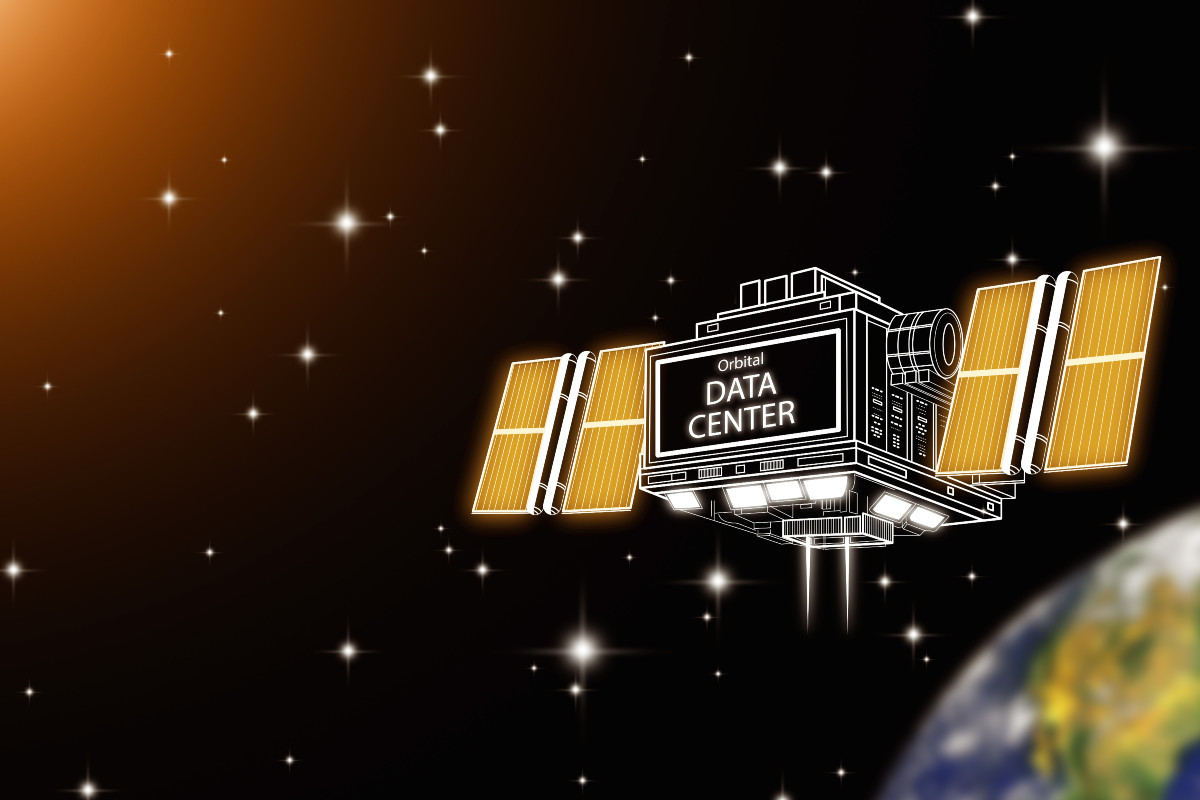
Ivo Ivanov, Chief Executive Officer at DE-CIX, examines how orbital compute is entering the infrastructure conversation – and why an interconnection layer in space could become critical to future AI performance.
AI’s next challenge isn’t intelligence, it’s infrastructure. The scale at which models are being trained and deployed is already pressing up against very real limits on Earth, from constrained grid capacity to long planning and permitting cycles for new data centres.
In many regions, the availability of power and cooling is shaping where AI can grow and how quickly. That pressure is forcing the industry to look beyond familiar ground-based assumptions and ask uncomfortable but necessary questions about where future compute should live, and how it can be sustained over the long term.
This is why the idea of placing AI compute in orbit has moved from the realm of sci-fi to serious discussion. Continuous solar exposure and the ability to dissipate heat through radiation address two of the hardest problems facing terrestrial infrastructure today – power and cooling. Industry players, including Google, are already exploring the concept through initiatives such as Project Suncatcher, which looks at how machine learning could scale in space. Rather than pointing to a single destination, these efforts are examining a range of orbital environments where energy and cooling dynamics differ fundamentally from those on Earth.
These approaches are not being developed to replace Earth-based data centres, but to extend the digital infrastructure stack into an environment where energy and cooling constraints look very different. If and when this happens, the implications go far beyond hardware in space. Any meaningful use of orbital compute will depend on how data moves between Earth, orbit, and the edge, and whether those pathways can support the performance, predictability, and resilience that modern AI workloads demand.
Orbital compute and the new infrastructure stack
Thinking about compute in orbit requires a shift in how we think about the digital infrastructure stack. Space-based systems are unlikely to replace terrestrial data centres, regional hubs, or edge locations, but they are increasingly likely to sit alongside them as part of a more distributed architecture.
Training workloads that demand enormous amounts of energy, or that can tolerate some physical distance from end users, may be better suited to orbital environments over time. Latency-sensitive applications, regulatory requirements, and proximity to data sources will continue to anchor large volumes of compute on the ground. This is unlikely to be a binary choice between Earth and space, but rather a layered ecosystem in which different environments serve different purposes.
As that ecosystem takes shape, workload placement becomes as much a network problem as a compute one. Data will need to move predictably between orbital platforms, terrestrial data centres, and edge locations that support real-time services. That raises practical questions for operators about routing, resilience, and how traffic paths are engineered across vastly different physical environments.
Space-based systems will only be viable at scale if they can participate in the same structured, high-performance connectivity models that underpin today’s Internet, particularly when it comes to interconnection and direct connectivity. Without that integration, orbital compute risks remaining limited to narrower or more specialised use cases.
Space-based interconnection
If compute extends into orbit, one of the biggest hurdles will be how that compute is networked. Satellites cannot operate as isolated endpoints if they are expected to support AI workloads that rely on continuous data exchange with applications, users, and data sources on the ground. They need structured pathways for traffic to move between multiple networks, platforms, and locations, both in space and on Earth.
This reflects a familiar principle in terrestrial networking: performance and scale improve when neutral interconnection models are in place.
Internet exchanges (IXs) offer a way for networks to exchange traffic efficiently, securely, and with predictable performance. Extending that model into space could create an orbital interconnection layer, where traffic is exchanged locally in orbit rather than being routed back to Earth for every interaction.
Concepts, such as Space-IX, build on existing peering and routing practices rather than reinventing them, offering a framework to manage latency, improve resilience, and support the growing complexity of future AI-driven services. If space becomes part of the digital backbone, interconnection will be a critical control layer in determining how well that backbone functions.
Space lasers and Earth-orbit reality
We have known for some time that latency and predictability matter just as much as raw connectivity when it comes to AI workloads. Many AI-supported services depend on near-real-time interaction with users, systems, and physical environments, which leaves little tolerance for congestion or unpredictable routing. While radio-based satellite systems have expanded coverage and reach, they can struggle to deliver the bandwidth and consistency required at scale, particularly as traffic volumes increase. Bottlenecks introduce delay, and delay quickly becomes a limiting factor for AI performance.
That is why optical, laser-based communication is drawing so much attention. Free-space optical (FSO) links can support significantly higher data rates with far greater precision than traditional radio signals, making them well suited to the demands of AI-driven data exchange. At the same time, they introduce real technical challenges. Atmospheric conditions, cloud cover, and turbulence can disrupt beams and complicate reliable handover between satellites and ground stations. Projects such as the European Space Agency’s OFELIAS initiative are focused on addressing these limitations through improved protocols and smarter coordination between space and terrestrial networks. The success of orbital compute will depend on whether these optical links can deliver the same consistency and performance that operators expect on the ground.