

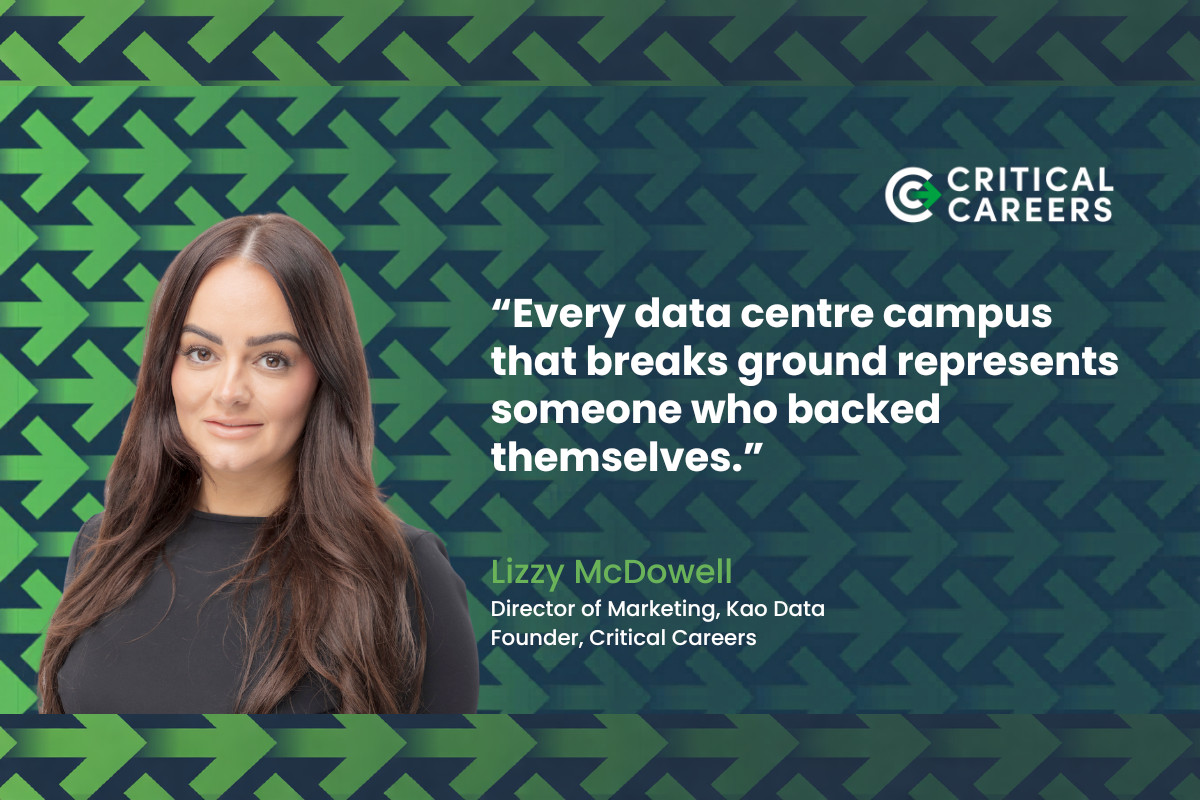
Lizzy McDowell, Director of Marketing at Kao Data, explores why confidence remains one of the biggest unspoken barriers for women in digital infrastructure, and how sharing real stories can help break the cycle.
I want to talk about something that doesn’t appear on any org chart, doesn’t feature in any job description, and is very rarely discussed openly in our industry: confidence. Or, more precisely, the quiet absence of it.
Last month, I wrote about why I launched Critical Careers and what we’re trying to achieve at Kao Data. The response honestly blew me away. But what really caught my attention was what people said to me privately, away from the comment sections and conference floors. Women in this industry kept telling me the same thing, in different words but with the same feeling behind it, ‘I have often wondered if I really belong here’. That may seem difficult to believe, but it’s true.
That stopped me in my tracks. Because these weren’t graduates or early-career professionals finding their feet. These were established, capable leaders: women running teams, managing multi-million-pound projects, advising boards. And they were still carrying that nagging voice in the back of their heads, telling them they weren’t quite enough.
The industry that rewards boldness
Let’s be honest about our sector for a moment. Digital infrastructure is built on bold decisions. Every data centre campus that breaks ground represents someone who backed themselves and their team, took a calculated risk, and went for it. Every power strategy, every land deal, every hyperscale contract won – these things don’t happen unless they’re underpinned by confidence.
Innovation in this industry demands it. You need confidence to challenge a design assumption. You need it to propose a new cooling approach that hasn’t been tried before. You need it to walk into a boardroom and tell the people holding the budget that there’s a better way to do things.
But here’s where it gets complicated. For women, developing that confidence often comes with an additional set of hurdles that our male colleagues simply don’t face.
The numbers behind the feeling
The data centre workforce is still overwhelmingly male. According to the Uptime Institute, women make up just 8-10% of data centre teams – a figure that has barely shifted in half a decade. In the broader technology sector, research from Hays found that 68% of women working in tech experience imposter syndrome, compared to 61% of men. And perhaps most tellingly, over a third of women in tech say those feelings of self-doubt have become more frequent as their careers have progressed, not less.
Digest that for a moment. The more senior women become, the more they doubt themselves. That’s not a personal failing. That’s a fundamental systemic signal.
When you work in an environment where you rarely see someone who looks like you in a leadership position – and a recent KPMG study found that 75% of female executives across industries have experienced imposter syndrome – it becomes easy to internalise the idea that you are somehow the exception rather than the evidence of what’s possible. A Vodafone study found that six in ten women said they would be more likely to apply for a role if they could see other women already in leadership positions. Visibility isn’t a nice-to-have. It’s a critical catalyst.
Confidence isn’t the problem. Context is.
I should be very clear: I don’t think women lack confidence because something is wrong with them. I think the environments many of us work in haven’t been designed – or haven’t evolved enough – for us to feel confident. There’s a difference.
When you’re the only woman in a room full of male colleagues, it takes a different kind of inner strength to speak up. When you’re pitching an idea and you can sense that the default assumption is scepticism rather than interest, it wears you down over time. When you look at the leadership page of most data centre operators and see row after row of similar faces, it’s hard not to draw internal conclusions about where the ceiling is.
I’ve felt this myself. There have been moments in my career where I’ve questioned whether I should be in the room, whether my perspective was valid, whether I’d earned my place at the table. And every single time, I was wrong to doubt myself. But the doubt didn’t come from nowhere. It came from the signals around me.
What stories can do
This is exactly why Critical Careers exists. Not to lecture. Not to produce another report that gets filed and forgotten. But to show women at all levels, through the real experiences of their peers, that they are not alone in feeling this way – and that those feelings don’t have to define their trajectory.
Libby Milne, a project manager at Buro Four working in the data centre sector, put it brilliantly when she spoke about what first drew her to the industry. It wasn’t a careers leaflet or a university open day. It was her dad taking her to a construction site. Something clicked because she could see herself in it. That’s the power of exposure. That’s what happens when someone opens a door and says, ‘This could be yours’.
Every woman featured in the Critical Careers book, on our podcast, and at our events has a version of that story. A moment where they found their footing, not because the doubt disappeared, but because they pushed through it with the support of someone who believed in them. Sometimes it was a mentor. Sometimes it was a peer. Sometimes it was simply reading about someone else’s journey and realising: if she can do it, maybe I can too.
From inspiration to action
Storytelling is so important, but stories alone aren’t going to cut it. The data centre industry is growing at a pace that outstrips almost every other infrastructure sector. Investment is unprecedented, demand is relentless, and the talent pipeline is struggling to keep up. We need more people. Full stop. And we won’t get them if half the population doesn’t see digital infrastructure as a place where they can thrive.
That means creating spaces where women can build confidence together, not in isolation. It means normalising the conversation around doubt and imposter syndrome so that it becomes something people address openly, rather than something they carry alone. It means ensuring that when a young woman looks at our industry for the first time, she doesn’t just see data halls and backup generators. She sees people she can genuinely relate to, doing extraordinary work.
Of course, it also means that the men in this industry have a role to play. Not as saviours, but as allies. Sponsoring women for opportunities. Amplifying their voices in meetings. Recognising when someone is being talked over and making space for them to finish their point. These things sound small and trivial. They’re not.
An invitation
If you’re reading this and you’ve ever felt like you don’t quite belong in this industry, I want you to know something: you do. Your doubt is not evidence that you’re out of your depth. It’s evidence that you care. And caring about doing good work is exactly what this industry needs more of.
Critical Careers will keep telling these stories. We’ll keep creating spaces for honest conversations. And we’ll keep pushing for an industry that doesn’t just talk about diversity, but builds the culture and foundations to support it.
Because confidence isn’t something you’re born with. It’s something you build. And sometimes, all it takes to start building is seeing someone else who’s already standing where you want to be.
See you next month.