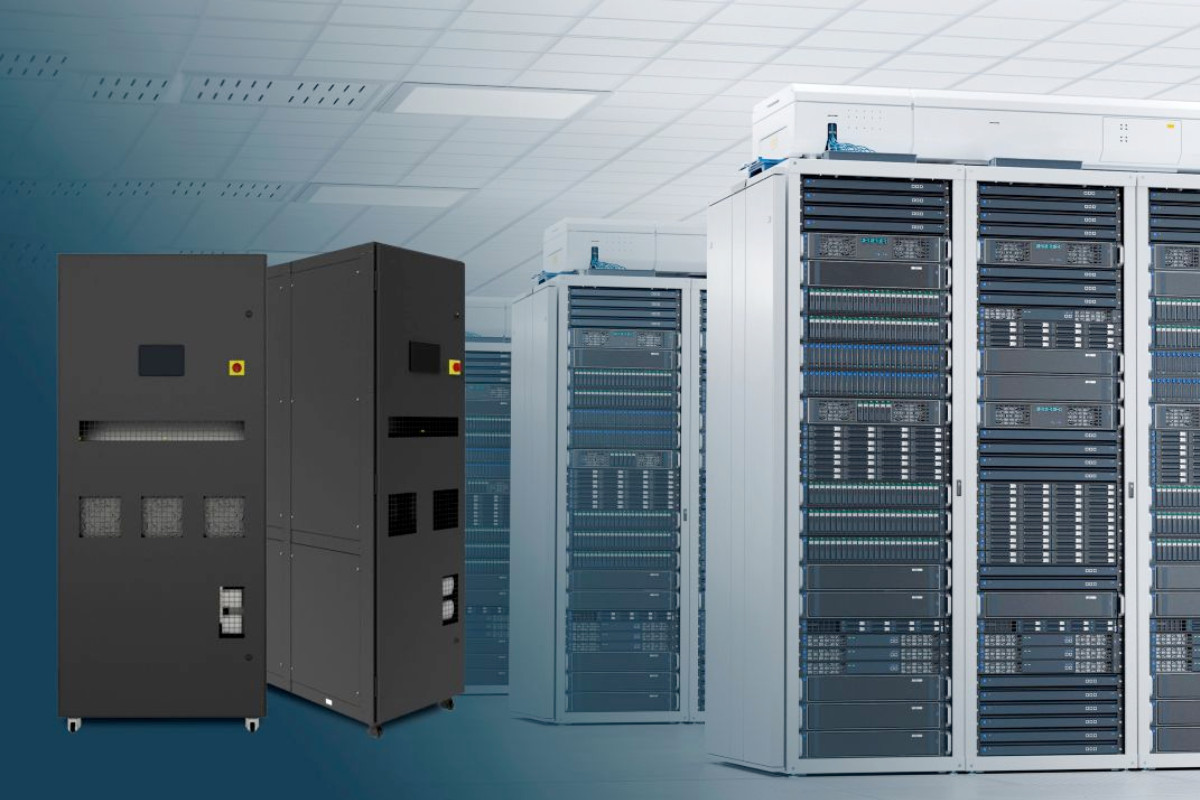
Panasonic has launched a new liquid cooling systems business for generative AI data centres in Europe, with orders now open for a range of coolant distribution units (CDUs) and free-cooling chillers.
The move builds on Panasonic’s acquisition of Italy-based Tecnair in 2023. Tecnair manufactures close control air-conditioning units used in data centre air-cooling, and the deal gave Panasonic a stronger position in the European cooling market. With the addition of CDUs and data centre chillers, Panasonic is now broadening its offer beyond traditional air-cooling as operators face rising heat loads from AI infrastructure.
The two CDU models are rated at 400kW and 800kW, alongside two free-cooling chillers with capacities of 800kW and 1,200kW. Panasonic is also developing higher-capacity CDUs of 1,200kW and above.
The launch comes at a time when data centre construction is accelerating and operators are under growing pressure to manage the heat generated by high-performance computing. While air-cooling has long been the standard approach, generative AI workloads are changing the equation. The high-performance GPU chips used for advanced computational processing generate far greater thermal loads, pushing more operators towards liquid cooling systems that can remove heat more efficiently.
Panasonic has long been established in the data centre market, although it focused on air cooling, rather than liquid cooling. Now, with the hyperscalers and colocation providers now requiring liquid cooling to meet AI workloads, Panasonic is responding with a whole new range to meet those requirements – while still leaning on its strengths in the air cooling market.
That’s because, according to Panasonic, its new CDUs are designed to perform heat exchange and distribute coolant using chilled water supplied by chillers. In effect, that gives operators the option to combine liquid cooling with more established air-cooling systems, rather than relying entirely on one or the other.
That matters because few operators are approaching the AI transition from a blank sheet of paper. Many are looking for ways to support denser deployments within existing facilities, and hybrid cooling strategies are becoming an increasingly practical route. Panasonic argues that combining traditional air-cooling with liquid cooling can help reduce power consumption while also cutting the overall system footprint needed to achieve the same cooling capacity.
Alongside the CDUs, Panasonic has also developed its first chillers specifically aimed at data centres. These have been positioned towards small to medium-scale facilities, including edge data centres, and incorporate a free-cooling function that uses lower outdoor temperatures to generate chilled water.
The company notes that its free-cooling capability is designed to operate at outdoor temperatures of up to 10°C, which could make it particularly relevant in parts of Europe where ambient conditions allow operators to reduce reliance on mechanical cooling for significant parts of the year. In those cases, the energy savings could be meaningful, especially as power use remains one of the biggest commercial and operational pressures facing the sector.
The chillers also use the low-GWP refrigerant R1234ze(E), which has a global warming potential of 1. While the main driver for adoption is likely to be cooling performance and efficiency, the use of lower-impact refrigerants is becoming an increasingly important consideration as operators and suppliers come under more pressure to demonstrate progress on sustainability.