

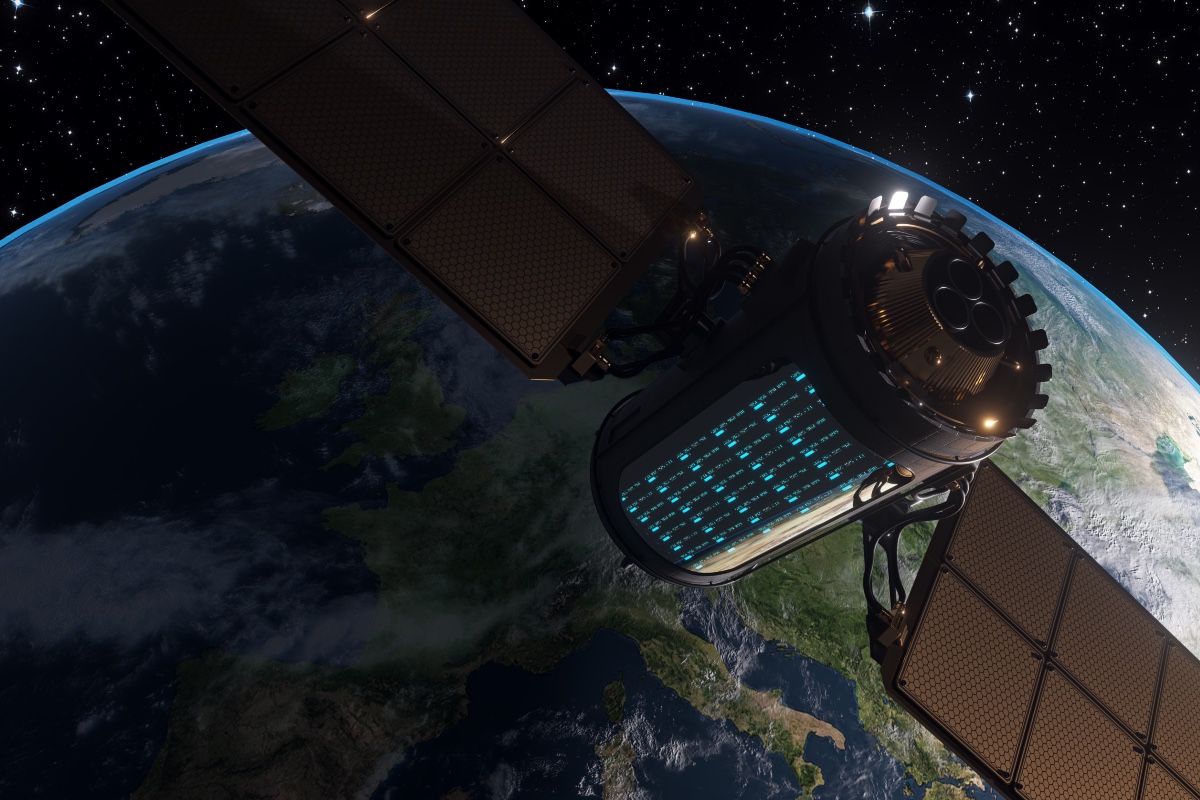
Could moving some compute beyond Earth help overcome the infrastructure constraints holding back AI growth? Sean P. McDevitt, Partner at Arthur D. Little, explores the opportunities and engineering challenges presented by orbital data centres.
As demand for AI infrastructure accelerates, conventional data centre development is encountering increasing physical and regulatory constraints. In some regions, projects now face electricity grid connection queues extending beyond seven years, alongside water availability constraints, planning approvals and growing community opposition. These factors are placing significant pressure on deployment schedules.
At the same time, orbital computing has progressed from theoretical concept to early-stage operational validation. Recent demonstrations of GPU-based processing in orbit have indicated the technical feasibility of space-based AI workloads, while SpaceX has announced plans for the first generation of its orbital data centre satellite programme.
The debate is therefore shifting. The central question is no longer simply whether compute infrastructure can operate in space, but whether orbital deployments can remove more constraints than they create. How can orbital data centres complement traditional infrastructure, and under what conditions could they become commercially viable?
Why terrestrial infrastructure is becoming a limiting factor
Historically, compute itself was the primary constraint on AI development. Today, the availability of supporting infrastructure is becoming a more significant challenge. For AI infrastructure, speed to power is increasingly becoming as important as access to compute.
Reliable power supplies, grid connectivity, cooling capacity and water resources are increasingly determining how rapidly new AI capacity can be deployed. Lengthy planning processes, environmental regulation and community resistance further extend project timelines while increasing development costs and stakeholder management requirements. For example, according to Data Center Watch, at least 75 data centre projects worth more than $130 billion were delayed or cancelled in the first three months of 2026.
These delays have important commercial implications. Infrastructure delivered after the next AI model refresh cycle may generate reduced economic value, shortening the period over which operators can realise returns on investment.
Against this backdrop, orbital computing is emerging as a potential alternative. Demonstrations involving H100-class GPU payloads have validated AI processing in orbit, representing an important milestone for space-based compute. In parallel, SpaceX has announced its AI1 orbital data centre satellite and plans to establish a manufacturing facility in Texas capable of producing these systems from 2027 onwards.
How orbital data centres differ from conventional facilities
Orbital data centres are expected to operate as constellations of low Earth orbit (LEO) satellites positioned approximately 400-1,400 kilometres above the Earth’s surface. Satellites at these altitudes complete an orbit every 90 to 120 minutes, with selected orbital paths providing near-continuous solar exposure while maintaining significantly lower communications latency than deep-space alternatives.
Unlike terrestrial hyperscale facilities, orbital data centres will not consist of single, large-scale installations. Instead, they are likely to comprise distributed networks of modular compute satellites working collectively.
For example, SpaceX says that its AI1 platform will provide approximately 150 kW of peak compute power and around 120 kW under normal operating conditions. By comparison, modern hyperscale data centres can operate with power capacities measured in gigawatts.
Rather than competing directly with hyperscale facilities, orbital systems could support specialist workloads where deployment in space offers structural advantages. These include access to near-continuous solar energy, a radiative thermal environment that avoids water-based cooling while still requiring sophisticated thermal management, processing of data generated directly in orbit, and enhanced resilience through geographically independent infrastructure.
Understanding the core engineering requirements for orbital compute
Although enabling technologies continue to mature, successful orbital data centres depend upon several critical engineering disciplines.
Efficient power generation
Continuous operation requires highly efficient solar arrays capable of withstanding radiation exposure and extreme operating conditions. Advanced energy storage systems must also accommodate orbital transitions, temporary eclipses and contingency scenarios while meeting stringent mass and reliability requirements.
Effective thermal management
Satellites experience rapid temperature variation as they transition between direct sunlight and the Earth’s shadow, with thermal conditions ranging from approximately +120°C to -250°C. Effective thermal management therefore depends upon sophisticated heat dissipation technologies, conservative power densities and intelligent workload scheduling.
Resilient compute architecture
Orbital computing platforms require radiation-hardened hardware, extensive system redundancy and high levels of autonomous operation. Modular hardware architectures capable of supporting in-orbit replacement or upgrading will also become increasingly important as deployment scales.
High-capacity communications networks
Distributed compute satellites rely upon high-capacity optical inter-satellite communications to exchange data efficiently before transmitting information through scalable ground gateway infrastructure, while securely managing substantial data volumes.
Cost-effective launch economics
Launch costs currently represent approximately 40% of total deployment expenditure. Reductions in launch costs would therefore have a significant impact on the economics of orbital infrastructure. SpaceX’s Starship programme, for example, is targeting launch costs below $100 per kilogram, compared with historical ranges of $2,000-10,000 per kilogram. If achieved, such reductions could substantially improve the long-term commercial case for orbital infrastructure.
The ability to assemble and maintain facilities in orbit
Large-scale orbital data centres will require robotic assembly, autonomous maintenance and routine hardware replacement. Standardised module designs and high levels of automation will therefore be important to achieving commercially sustainable operating models.
Where orbital compute creates value
Orbital infrastructure is not a simple replacement for terrestrial data centres. Instead, operators could integrate orbital compute alongside conventional facilities, deploying workloads where the benefits of space-based infrastructure outweigh its additional complexity.
Potential applications broadly fall into three categories:
- In-orbit edge computing, where data from Earth observation satellites, radio frequency monitoring systems and spacecraft telemetry is processed directly in space, avoiding the bandwidth requirements of transmitting large raw datasets back to Earth.
- Resilience and digital sovereignty, by providing geographically independent repositories for critical datasets, AI model checkpoints and immutable system logs, supporting business continuity where terrestrial redundancy alone may prove insufficient.
- Latency-tolerant batch processing workloads. In these scenarios, access to solar energy and infrastructure availability may be more valuable than achieving millisecond response times, potentially making orbital deployment an alternative for selected compute-intensive operations.
The commercial outlook and remaining challenges
Orbital data centres have progressed beyond conceptual research and into early technical demonstrations, with commercial deployment becoming an active area of industry interest. However, widespread adoption will ultimately depend upon their economic competitiveness versus terrestrial alternatives.
Essentially, the additional costs associated with launch, deployment and orbital operations must remain lower than the financial impact of overcoming terrestrial infrastructure constraints if orbital data centres are to gain wider adoption. On the technical side, orbital platforms must also deliver a competitive cost per compute hour while supporting regular hardware refresh cycles and maintaining long-term system reliability. Finally, regulatory frameworks governing orbital traffic management, spectrum allocation and cybersecurity will significantly influence deployment timelines, operational models and market participation.
A complementary layer within future AI infrastructure
The primary constraints affecting AI infrastructure are increasingly external to computing technology itself. Power availability, permitting, cooling capacity and physical infrastructure have become defining factors in deployment planning.
Orbital compute will not eliminate every infrastructure challenge. However, for carefully selected workload types, it could offer a means of transforming physical limitations into architectural opportunities, bypassing some of the constraints that increasingly restrict terrestrial expansion.
Rather than replacing conventional data centres, orbital infrastructure could emerge as an additional layer within a broader hybrid AI ecosystem. As technical capability matures and commercial business models evolve, organisations may increasingly assess which workloads, if any, could benefit from orbital deployment as part of their long-term infrastructure strategy.