

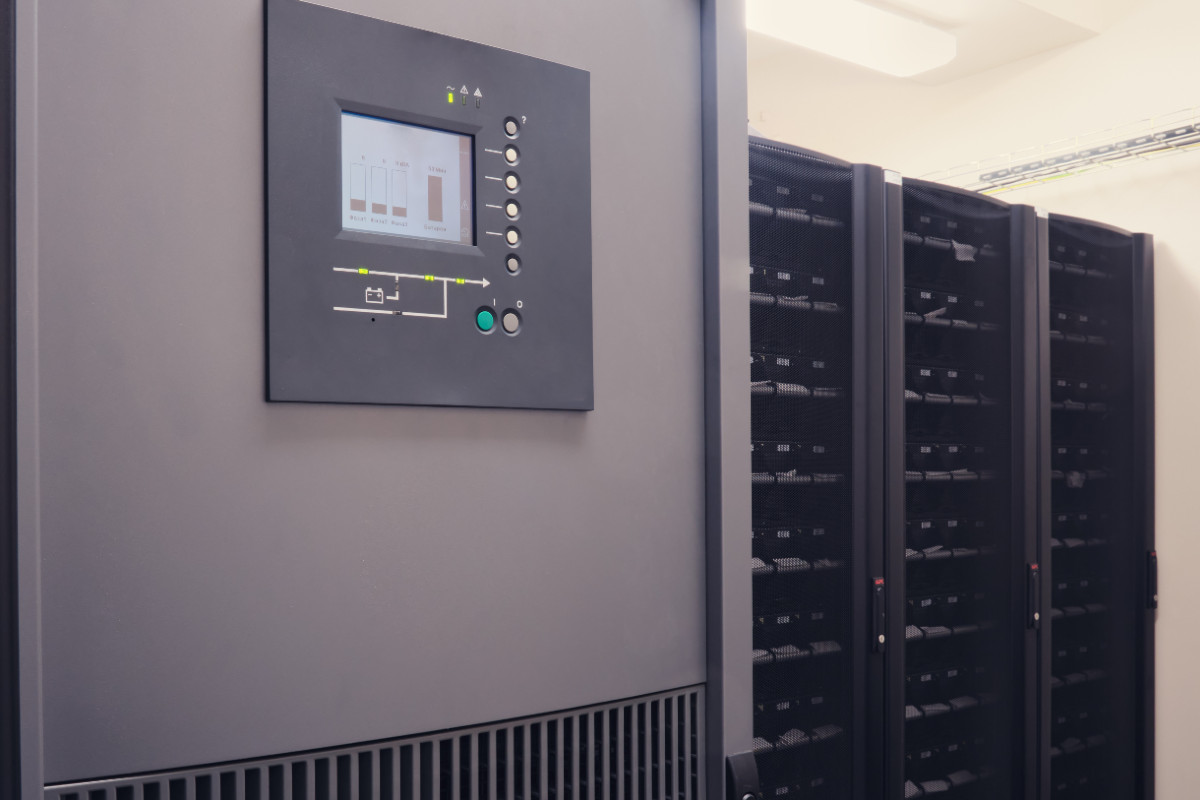
Michael Nagus, CEO of LiNova, explores why the systems designed to protect data centre uptime can become a serious vulnerability if battery safety is treated as an afterthought.
Data centres are now among the most mission-critical facilities in the world, underpinning artificial intelligence (AI), cloud services, financial systems, healthcare platforms, and defence infrastructure. Uptime is paramount for these industries, as any disruption can trigger significant financial losses, reputational damage, and compliance consequences. Studies estimate that the hourly cost of downtime can exceed $300,000 and, in many cases, surpass $1 million.
Given these stakes, data centres are held to the highest expectations of availability: five-nines uptime. While the difference between three nines and five nines may sound minor, it amounts to hours of additional downtime each year – an unacceptable margin in an AI-driven economy.
So how do we preserve uptime? Cyberattacks may dominate headlines, but the leading cause of data centre outages remains far more fundamental: power failure. And too often, those failures originate in the very systems designed to prevent them.
Rack-level backup battery units (BBUs) and centralised uninterruptible power supply (UPS) systems are meant to provide emergency power and resilience, yet when these systems falter, the consequences are immediate.
As operators modernise their UPS infrastructure to support rising power demands and AI workloads, many are moving beyond traditional lead-acid batteries. But upgrading for power density and footprint alone is not enough. If uptime is the goal, safety must also be part of the equation from the start.
The risk of thermal runaway in UPS batteries is no longer hypothetical. High-profile battery fires have shown how quickly a single failure can escalate into a facility-wide crisis.
In 2025, a data centre fire in South Korea, triggered by thermal runaway in a UPS system, disabled hundreds of government systems and took 22 hours to extinguish. Incidents like this are forcing operators to rethink how they evaluate battery safety and how it is assessed across the entire lifecycle of backup power systems.
That reassessment is becoming particularly important during UPS refresh cycles, when operators often focus heavily on runtime requirements, footprint optimisation, and energy efficiency. Those factors matter, but refresh cycles also create an opportunity to evaluate how battery systems behave under abuse scenarios, how failures are isolated, and how quickly issues can be detected before they escalate.
Battery monitoring and maintenance are central to these conversations. Teams should evaluate whether their monitoring systems provide real-time visibility into temperature, voltage, impedance, and cell-level anomalies, including the ability to identify degradation trends before failures occur.
Maintenance strategies should also extend beyond scheduled inspections to include clear protocols for testing, replacement, and end-of-life management. In many facilities, battery systems remain out of sight and out of mind until an emergency exposes weaknesses in maintenance practices.
Fire suppression and room design are also receiving greater scrutiny as energy storage deployments scale. Operators are reassessing ventilation requirements, thermal containment strategies, spacing between racks, suppression system compatibility, and emergency access procedures.
Some facilities are incorporating additional layers of compartmentalisation to prevent failures from cascading across systems, while others are redesigning battery rooms altogether to account for evolving fire codes and insurance requirements.
Similarly, some facilities are turning to alternative battery chemistries, including lithium titanate oxide, nickel-zinc, and designs based on non-metal or organic cathodes, to address thermal runaway risks. While some approaches have historically come with trade-offs in cost, energy density, or cycle life, the shift signals something important: avoiding catastrophic failure is becoming a priority on par with performance and price.
Choosing batteries with a lower risk of thermal runaway is not just about compliance. It is an operational decision with real business implications. Depending on the system and local requirements, such batteries may simplify permitting and inspections, reduce insurance exposure, and limit the amount of floor space dedicated to fire suppression and containment.
That reclaimed space can instead support revenue-generating infrastructure. In some cases, safer systems may also accelerate deployment timelines by reducing regulatory friction.
Insurance providers are paying closer attention to this. As battery-related incidents become more visible, underwriters are increasingly evaluating how facilities assess and mitigate thermal risk. Questions around incident response planning, emergency shutdown procedures, firefighter coordination, and suppression readiness are becoming part of the underwriting process. In some cases, operators may face higher premiums or additional compliance obligations if battery safety strategies are not clearly defined.
None of this suggests that safety should replace cost and performance in the decision-making process. Cost, cycle life, and performance still matter. But safety can no longer be treated as secondary. It belongs in the same tier of decision-making as cost per kWh and power density.
Encouragingly, advances in battery materials and design suggest that safety does not always have to come at the expense of performance or affordability. Emerging approaches that avoid oxygen-releasing metal oxide structures aim to improve stability under abuse conditions while still meeting the cost and performance demands of modern data centre infrastructure.
The modern data centre’s licence to operate depends on public trust and investor confidence as much as technical performance. Communities are increasingly scrutinising large, energy-intensive facilities, and highly visible battery incidents only heighten that scrutiny.
The most successful operators will be those who recognise that resilience is not just about redundancy, but about designing out preventable risk. In today’s environment, that means treating battery safety as an integral part of resilience.