
AI may be transforming software, but its biggest physical consequence is heat. Oliver Sanders, Data Centre Commercial Director UK&I at Carrier, explores why data centres need a new cooling mindset for the high-density era.
AI has dominated boardrooms, campaigns and technology conversations over the past year. We hear plenty about the magic: generative models, faster output and the next era of computing. But at an infrastructure level, AI is electricity becoming heat. It is power converted into calculations, with heat as the unavoidable by-product. And as the workloads scale, the rules for managing that heat are changing fast.
Why density is changing the cooling equation
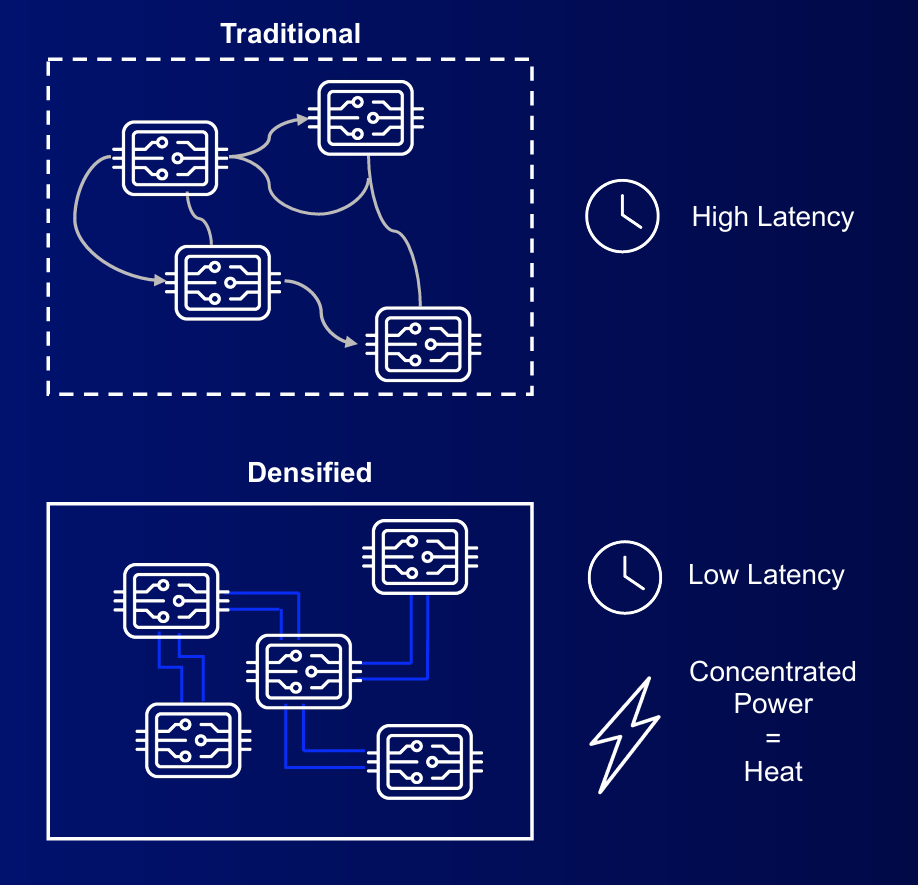
First, let’s ask: why are we densifying? Why are we packing 100 or 200 kW into a rack? We’re not doing it to save on floor space. We’re doing it to move data faster and reduce latency. But when you shrink the distance between chips and concentrate that power, you put a huge amount of heat into a tiny box. And the constraint is physical: all that heat must go somewhere.
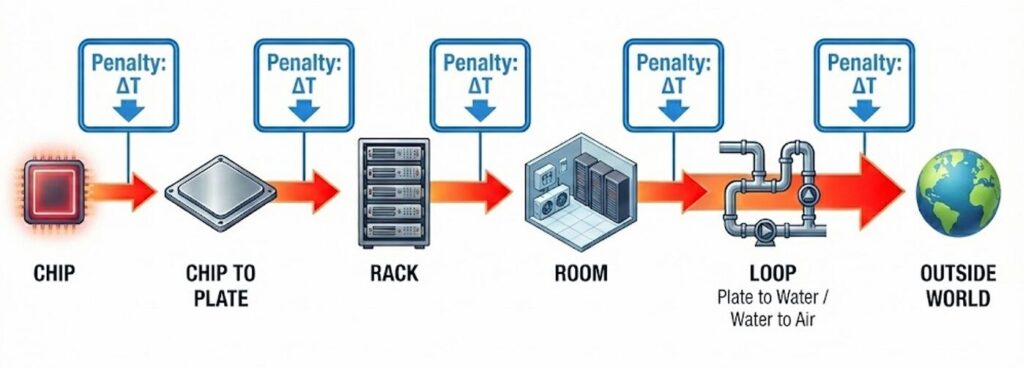
Therein lies the challenge. The data centre cooling industry tends to treat this problem in ‘slices’. IT buys the servers. Contractors buy the chillers. Engineers size the pipes. But heat couldn’t care less about job titles. It flows in a chain, from chip to rack to room to loop to the outside world. Every hand-off comes with a temperature difference (delta T) and a potential efficiency penalty. So, if each party only optimises its own slice, the inefficiencies compound.
If you take one thing away from this, remember the balance. To move heat, you need flow and a temperature difference. But as density rises, higher flow means massive pressure drops, huge pumps and enormous pipes. CapEx explodes. To overcome this imbalance, we have to stop designing with a ‘chip-forward’ mentality and start designing from the heat’s destination, working backwards to the chip.
There are a hundred brands selling a thousand products. But if you look at the physics, there are broadly four destinations for that heat. There is no hidden fifth route. Heat is either expelled into the air, rejected through evaporation, recovered for reuse or discharged into a large body of water.
The four routes for managing heat
- Dry cooling: Air can act as a virtually infinite sink globally, but locally it is finite and a relatively poor conductor of heat. To cool a 500 MW AI factory, you cannot simply blow air at 200 miles an hour and expect the efficiencies a data centre requires. You need to make the building bigger. Much bigger.
- Evaporative cooling: Water use is a sensitive issue, but evaporation is thermally powerful: far more efficient at rejecting heat than dry air. As densities double or triple, physics may force us to use more water. Without the phase change of water, heat may not be siphoned off fast enough.
- District heating: My favourite option. Where feasible, we reuse heat. We take heat from the rack and use it to heat homes and provide domestic hot water. The technology exists; the problem is geography. You need a population close enough to accept and use the heat. In the right location, waste heat can become a charitable contribution or a revenue stream.
- Direct water: Rivers, lakes, the sea. These are the ultimate thermal mass, absorbing heat almost instantly. But while river water does not care about a 100 kW data rack, the local ecosystem certainly does. Thermal pollution, regulation, corrosion and biofouling all create serious compromises, as even Microsoft’s underwater Project Natick showed.
Before you buy those GPUs, you need to know where the heat is going, because that decision dictates everything else inside the building. The problem is that one route is often not enough to cross the thermal wall, and every extra route adds cost.
Why liquid cooling still needs air
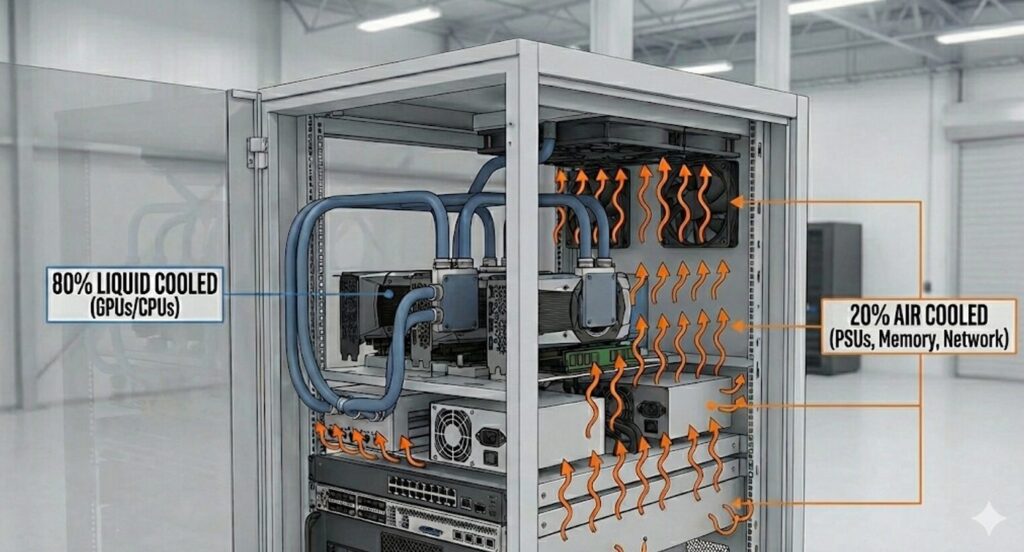
How, then, do we span the gap between legacy cooling and an AI liquid-cooled future without going bankrupt? The answer, at least for now, is bridge technology.
The ‘hottest’ heat-capture technology in the industry right now is direct-to-chip liquid cooling. It is thermodynamically superior and funnels heat directly away from the source – the chip. But here’s the reality check: pure, non-hybrid liquid cooling is a myth. Even in a rack full of liquid-cooled GPUs, power supplies, memory and networking gear still need air cooling. While we might capture 80% of the heat in liquid, the remaining 20% is still hot air.
The hybrid cooling trade-off
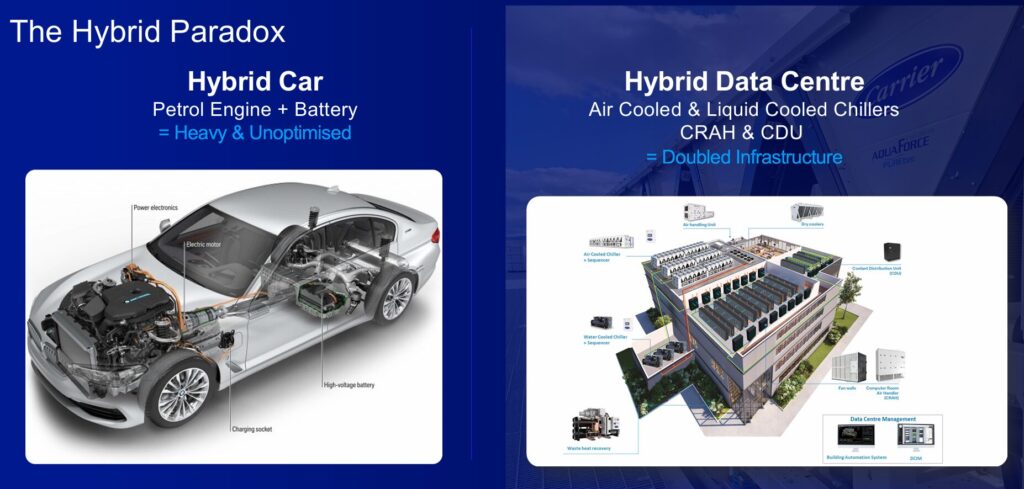
Think of the modern-day data centre as a plug-in hybrid car. On a physics level, a hybrid is technically not the best car. It’s heavier because it carries both a petrol engine and a battery, which means it is neither optimised for electric efficiency nor for petrol mileage.
Yet we in the data centre industry are doing the same thing. We’re building hybrid halls. We’re buying massive chillers for the air side and immense CDUs for the liquid side, thereby expanding our infrastructure footprint. Why do we build these expensive, heavy hybrids? For the same reason people choose to buy the car: security.
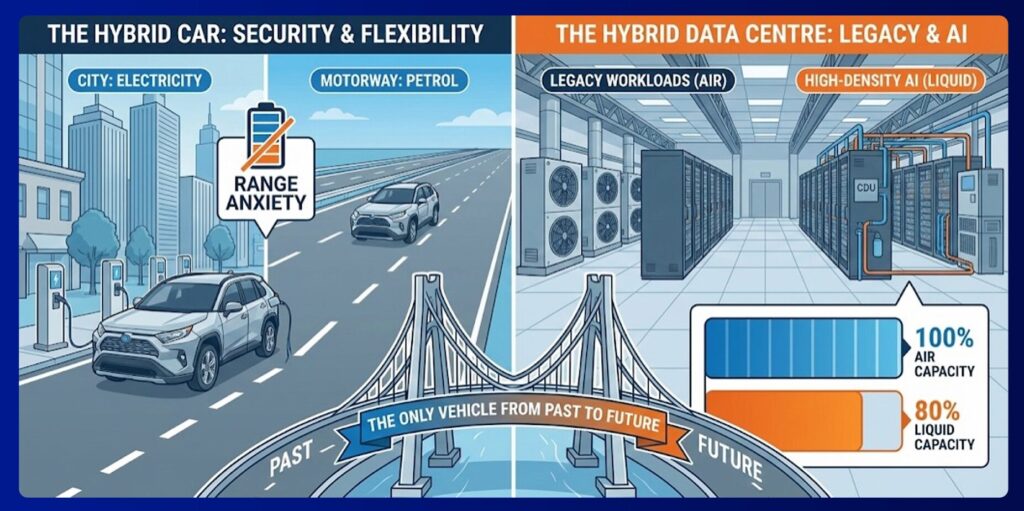
It can still do both jobs. In a hybrid-cooled data centre, legacy workloads and high-density AI can operate in the same room. It is an expensive bridge, granted, and you are likely paying for 100% air capacity and 80% liquid capacity at the same time. But right now, it’s the main vehicle for transporting us from the past into the future.
Designing for the full thermal lifecycle
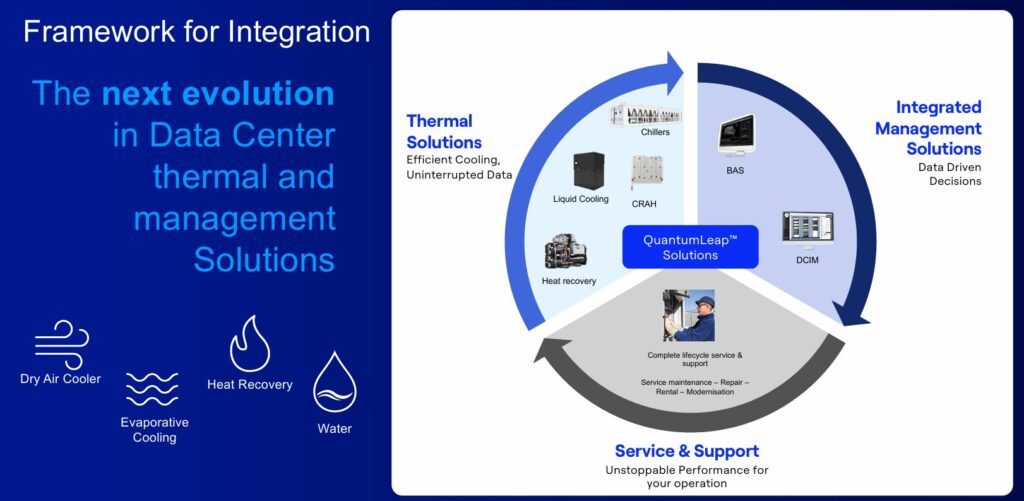
So, we are facing a thermal wall. To cope, we are building complex, heavy hybrid bridges. And we know physics gives us four ways to get the heat out. The temptation is to buy a bigger chiller or a stronger pump. But that is traditional thinking: trying to solve a system problem by oversizing individual components. To handle the gigawatt era, we need a fundamental shift in how we connect the chip to the atmosphere, water and heat recovery opportunities beyond the building.
That calls for integration: an approach designed to stop the ‘slicing’ problem, manage the hybrid cooling loop and deliver heat efficiently to the four destinations.
Here’s the takeaway: density is difficult to avoid. Hybrid is expensive. But it is necessary because the laws of physics are not going to change. The biggest risk to a data centre project isn’t buying the wrong chiller or CDU, but the gap between them and the failure to connect the physics of the chip to the physics of the destination.
Now here’s the challenge: before buying any components, stop looking at the chiller in isolation from the rack. Start designing for the entire thermal lifecycle. We’re entering an era where the data centre is no longer just ‘a big building with air conditioning’. It’s a complex thermal power plant with the promise of untold future opportunities. What it needs now is a change in mindset.