
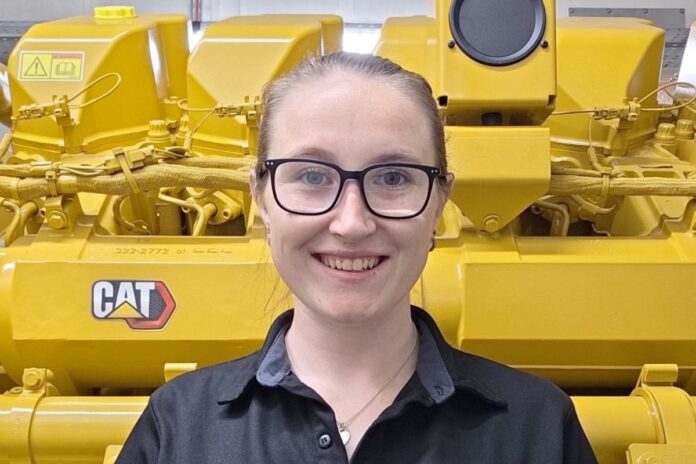
Katelyn Dunbar, a service engineer in Finning UK & Ireland’s data centre team, reflects on her apprenticeship journey and why visible role models and earlier encouragement matter if we’re serious about building the workforce that keeps critical infrastructure powered.
Not everyone has had an education in engineering like Katelyn Dunbar. Aged nine, she was building engines at the kitchen table alongside her father Paddy, ready for the weekends when they would hit the local Hot Rod race track.
Her Christmas list featured not the latest must-have toys but mechanical tools, and when it came to choosing which subjects to pursue at school, design and technology were her first choices. It was a learning experience like no other and marked out her first steps on a career path in engineering.
Today, following a four-year apprenticeship in service engineering with Finning UK & Ireland, the world’s largest Caterpillar dealer, Katelyn is a key member of the company’s data centre team, and the first woman in Ireland to complete a Finning apprenticeship.
From critical healthcare to next-gen retail and e-commerce experiences, data centres lie at the heart of the latest technological services – and it’s down to Katelyn and her colleagues to keep them powered.
A typical day ranges from troubleshooting issues to routine checks, diagnostics and repairs. But everything, down to completing the paperwork and following strict security procedures, is an essential part of the emergency backup system support which keeps the world online. Crucially, there’s no room for error.
Effective data centre management is vital for today’s businesses. The infrastructure is made up of four critical pillars that give the system its strength and resilience. This includes data security, energy efficiency, business continuity and optimised performance. The data centre team at Finning has to be the very best in its league to keep clients connected.
Katelyn’s goal is to take such good care of the power systems under her supervision that the digital world adapts seamlessly to future technical advances while maintaining long-term performance. In her care, these systems will be ready and active for when they are needed most.
“The world is so data hungry,” said Katelyn.
“The challenge now is meeting the demands for energy that data centres need but in a more sustainable way. Switching from diesel to HVO (hydrotreated vegetable oil) was a massive step forward and so far, we’ve been able to maintain a quality source of mission-critical power.
“Supporting continuous operations is vital. In data centres we tend to work on anything from a 12-cylinder to a 20-cylinder engine. The key is to take such good care of them that we don’t have to face rebuilds or massive repair jobs. Although for someone like me, I find the whole experience of rebuilding an engine absolutely incredible.
“I have worked on a Caterpillar 3618 high performance marine engine and that was massive. I’m 6ft tall and it is double the height of me. The apprenticeship allowed me to explore these other areas as well as specific generator training and by doing that we have a lot of ideas and experiences to draw on in our data centre support.
“Now after doing that engine rebuild course three years ago, I get to go back and do rebuilds with new apprentices where I’m the engineer.”
Based in Dublin, Katelyn is well placed to hone her skills. Ireland is now home to more than 80 data centres, contributing about €7.3 billion to the country’s economy. With some of Ireland’s biggest employers operating in the data centre industry, there is a steady stream of career opportunities to tap into.
As part of her apprenticeship, which saw her qualify as a level three electromechanical technician, Katelyn studied a range of courses to help her understand the vital role of maintaining system integrity. The multi-disciplinary training covered fuel systems, engine diagnostics and electrical fundamentals, among other applications. In a world where data generation is continually picking up speed, continuous learning and professional development is essential in a role which combines emergency call-outs and routine assignments.
“I started the apprenticeship with Finning straight from school,” said Katelyn.
“My father was a plant fitter in the construction sector, and it sparked my interest at a young age. Applying for the apprenticeship was a competitive process with only a few places available each year.
“But this is such a rewarding career. While we are relied on to respond to emergencies as well as routine repairs and maintenance, the ultimate output is that we are keeping the digital world running whether that be for hospitals or cloud users.
“There is a huge demand for the work we do and it is really supporting the Irish economy. I work in data centres, but the apprenticeship allowed me to explore similar roles in the construction, commissioning and marine industries. It’s hard work but we play a really important role, alongside other vendors and utility engineers, to keep industry powered.”
While Katelyn has her dad Paddy to thank for her passion for problem solving and understanding systems to improve product performance, she hopes to also play a part in inspiring the next generation of engineers.
Thinking back to her own journey, Katelyn believes deeply in encouraging young people, particularly girls, to consider engineering as a career before they get to secondary school.
“I don’t think girls are necessarily afraid of going for jobs in male-dominated industries,” she said.
“I think it is more the case that by the time we get to secondary school age, minds are already made up about the type of career someone wants to pursue.
“My own experience has been very positive and while it might have felt a bit daunting and intimidating to go into the workplace at first, what new job doesn’t feel like that? I believe if we have more women talking about their roles and achievements and acting as STEM advocates, children as young as primary school age will get used to thinking about how they can use their talents to make a difference.
“We might be able to plant those seeds before pupils move on to college or secondary school where science might start to seem less attractive as a career option.”
And Katelyn may well have a point. Research by Microsoft found that girls in the UK become interested in STEM subjects just before they turn 11 but this drops sharply when they turn 16. Education programmes tailored to supporting data centre functions are also on the rise but for Katelyn, staying curious is essential to gaining those technical proficiencies which make her expertise stand out.
As such a hands-on learner herself, whether it was trackside fixing up her dad’s Toyota Starlet at Wexford, dismantling an engine in cramped quarters on a ferry or leading a fault-finding mission at a data centre site, Katelyn believes apprenticeships are essential for providing opportunities for growth.
“To be honest, I’d never heard of a power systems engineer until I joined Finning,” she said.
“But if someone is interested in engineering they should just go for it. The more young people, especially girls, come forward and share their passion for engineering, then the likelihood is even more will follow. At the end of the day, the generators can’t go down.”