
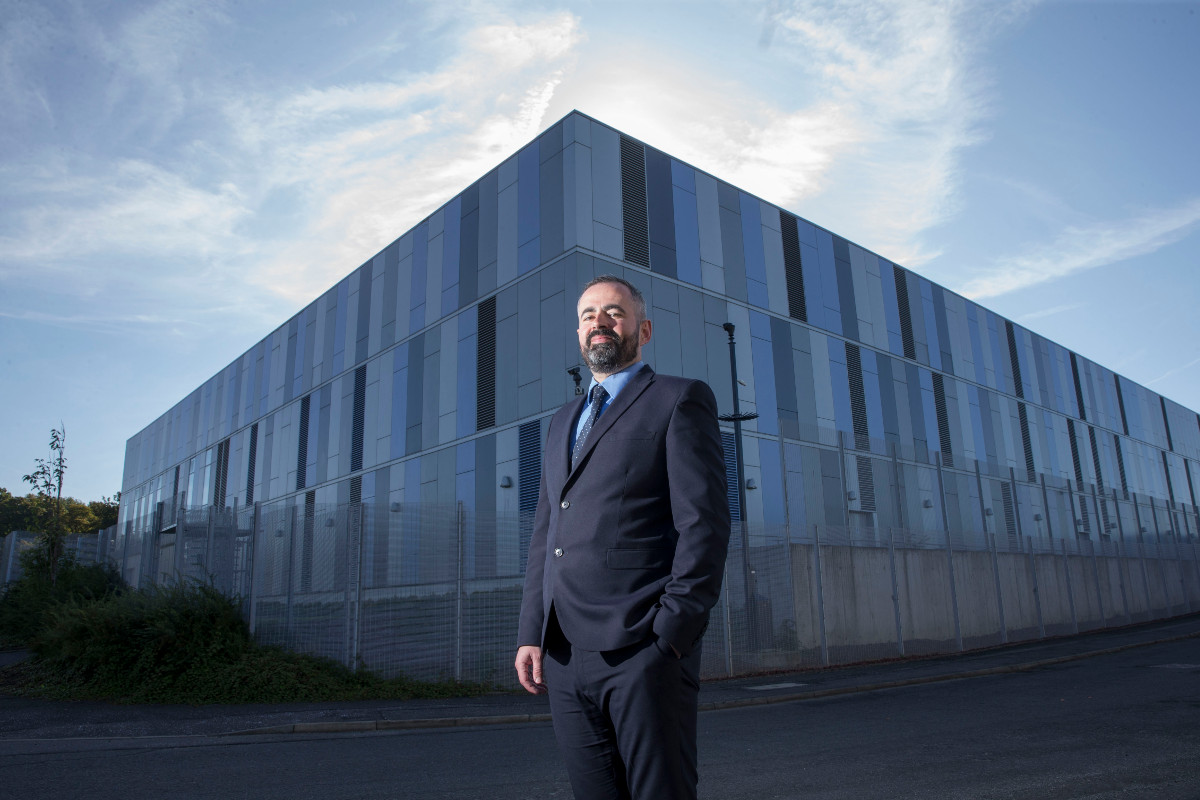
Lanarkshire has been named the UK’s latest AI Growth Zone, with the UK Government backing a major expansion around DataVita’s data centre site in the area.
This is the first AI Growth Zone located in Scotland, which has long been positioned as an ideal area to host one – given the abundance of renewable power that is available in the region. The Scottish Government has also been keen to promote the area in hopes of developing it into a leading zero-carbon, cost-competitive green data centre hub.
The Lanarkshire AI Growth Zone, which is the fifth AIGZ to be announced, is set to be based around DataVita’s campus, with the Scottish data centre firm delivering the site in partnership with AI cloud provider CoreWeave. That’s slightly different from other sites, which have often been positioned around multiple data centre operators, such as the North East Growth Zone, which is being centred around expansions to existing campuses from Cobalt Park Data Centres and the QTS Cambois.
Despite being centred around the one expanded campus, the UK Government still has big hopes for the site. In fact, it’s hoped that the site will bring more than 3,000 jobs to the area over the coming years, including 50 apprenticeships. Around 800 roles are expected to be higher-paid AI and digital infrastructure jobs, spanning everything from research and software to permanent staff running and maintaining data centres, with the remainder tied to construction and site development.
Alongside job creation, ministers are pointing to £8.2 billion of private investment, plus a community fund worth up to £543 million over the next 15 years, which the Government says will be raised as data centre capacity comes online.
What’s being built as part of the Lanarkshire AI Growth Zone
The Lanarkshire AI Growth Zone may be centred around DataVita and CoreWeave’s partnership, but that doesn’t mean it’s just a single facility. To the contrary, the site is expected to feature 100MW of AI-ready data centre capacity, over 1GW of renewable energy infrastructure connected via private wire, and ‘Innovation Parks’ intended to attract adjacent industries that want proximity to large-scale compute.
That extra power will be key to the deployment of this latest AI Growth Zone, with it seen as a key tenet of gaining the designation, but it should also go some way towards helping reduce public opposition. Another data centre located to the south of Glasgow in Hulford has seen intense local opposition due to its enormous power demands, with residents outraged that the site wouldn’t even need to calculate the environmental impact on the local area.
DataVita and CoreWeave will be keen to avoid the same backlash – which is why the companies are leaning heavily on a whole host of sustainability claims for its Lanarkshire AI Growth Zone. As well as using renewable energy to help power the site, the two firms also plan to make use of waste heat.
The current plan is that excess heat from cooling systems could, in time, be redirected to support the nearby University Hospital Monklands, described as Scotland’s first fully digital and net zero hospital – though that element is presented as something to be explored once the site is fully up and running, rather than a guaranteed near-term deliverable.
That would be a huge win for advocates of heat networks, with a recent report suggesting that waste heat from UK data centres could heat 3.5m+ homes – it could also help the site win favour with local residents who are impacted by the plans.
It’s not the only part of the plan that has been developed in a bid to win over residents. In fact, a community fund – worth up to £543 million over 15 years – will also be set up to support local programmes ranging from skills and training packages through to after-school coding clubs and support for local charities and foodbanks.
DataVita’s parent company, HFD Group, is also expected to contribute £1 million per year to local charities and community groups, on top of the Growth Zone community funding mechanism.
Industry reaction
Commenting on plans for the first AI Growth Zone in Scotland, the UK’s Technology Secretary Liz Kendall noted, “Today’s announcement is about creating good jobs, backing innovation and making sure the benefits AI will bring can be felt across the community – that’s how the UK government is delivering real change for the people of Scotland.
“From thousands of new jobs and billions in investment through to support for local people and their families, AI Growth Zones are bringing generation-defining opportunities to all corners of the country.”
Danny Quinn, Managing Director of DataVita, added, “Scotland has everything AI needs – the talent, the green energy, and now the infrastructure. But this goes beyond the physical build. We’re creating innovation parks, new energy infrastructure, and attracting inward investment from some of the world’s leading technology companies.
“This is a real opportunity for North Lanarkshire, and we want to make sure local people share in it. The £543 million community fund means the benefits stay here – good jobs, new skills, and investment that actually reaches the people who live and work in this area.”
Schneider Electric’s Matthew Baynes, VP, Secure Power and Data Centres, Schneider Electric, UK & Ireland, concluded, “In the twelve months since the introduction of the AI Opportunities Action Plan, the UK has seen much progress towards its AI ambitions.
“The new AI Growth Zone (AIGZ) announced today in Lanarkshire demonstrates just how far the country has come in its plans to build a sovereign AI nation, with Scotland becoming a critical new infrastructure hub and joining those in Wales, Oxfordshire, and the Northeast of England.
“Furthermore, the country has now secured more than £31B in investment from some of the world’s largest, leading tech companies, demonstrating that the UK has the people, resources and ambition to make AI a centrepiece of a new and revitalised Industrial Strategy.
“While this can be considered a success in many respects, there is still much work to do. Access to renewable power remains one of the biggest hurdles facing many parts of the country, and as the UK’s energy technology partner for data centres and AI Infrastructure, we believe there is a clear opportunity to catalyse the both the AI and green transitions by turning data centres into the energy centres of the future – fast-tracking new developments with behind-the-meter power generation and microgrids.
“Furthermore, the AIGZ announced today could not be more timely. We believe Scotland, with its cool temperate climate and rich conditions to generate renewable energy, provides a key opportunity to create secure, scalable and sustainable infrastructure capable of galvanising the AI race. Now, the UK’s sustainability and AI ambitions must work together hand-in-glove, demonstrating that today’s technology can be a catalyst for a greener future, powered by AI.”