
Action to Protect Rural Scotland (APRS) has stepped up its campaign against data centre development in Scotland, renewing calls for a moratorium on new proposals while the Scottish Government investigates their impact on electricity demand and sets a clear definition for what it means by ‘green data centres’.
The intervention comes hot on the heels of Edinburgh City Council’s recent decision to reject a data centre planned for the site of the former RBS HQ due to its inability to showcase its green credentials. Just days before that data centre went before the planning committee, APRS rallied against the plans, noting that it would have meant ‘100,000 idling cars-worth of diesel’ being burned if its generators were ever run at scale.
Now, APRS wants to go a step further. It’s beginning a series of events, both in-person and online, starting this week, aimed at connecting people who want to learn more about data centres with local campaigners already organising in their areas. APRS says the sessions will include speakers with experience of campaigning against large-scale data centre development, including Donald Campbell from Foxglove and Julie Bolthouse from Virginia’s Piedmont Environment Council.
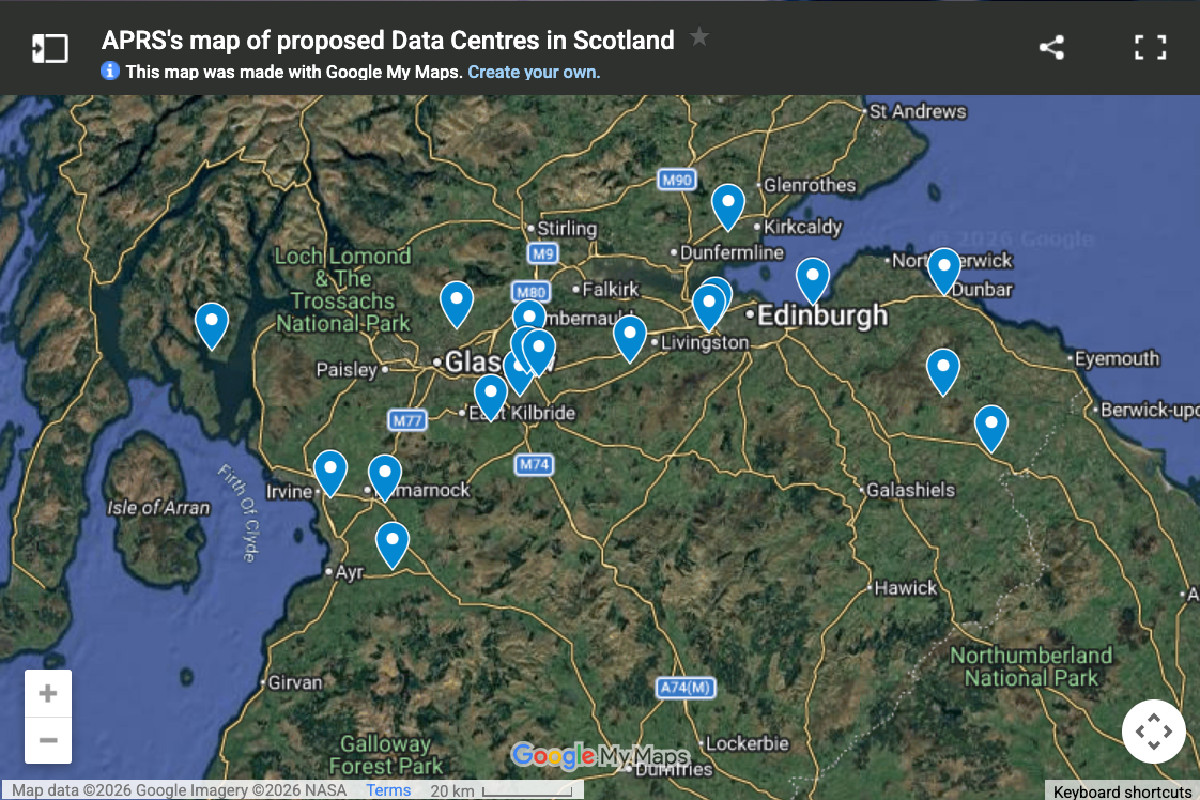
At the same time, APRS has published an interactive map of hyperscale data centre projects currently being planned in Scotland, with each proposal linked to a dedicated webpage containing planning documents and other information. While APRS is presenting the map as a practical resource for communities, it is also using the publication to underline the scale of the current pipeline – and the case, in its view, for a pause.
Dr Kat Jones, Director of APRS, noted, “It is vital that we get the information out to help people see the extent of the threat posed to Scotland by hyperscale AI data centres. This map gives a really accessible way of finding out where the data centres are, and to get involved locally.
“We hope this will prompt people to delve a bit more into how hyperscale data centres could affect Scotland, and join local groups protesting the data centres in their areas. There are already groups and individuals getting organised across the central belt against data centres and we are encouraging more groups to form so we can put their details on the map.”
What is a Green Data Centre?
The Scottish Government has a policy where it supports ‘green data centres’, but APRS argues the term currently lacks any meaningful definition – raising the risk that projects of very different sizes and purposes are treated as broadly equivalent.
For APRS, that distinction is central. The group is pushing ministers to draw a firmer line between data centres that support domestic and regional needs – such as cloud services, business systems and research computing – and hyperscale facilities aimed at global AI workloads, which it argues come with ‘orders of magnitude’ higher electricity demand and larger impacts on communities and land use.
Jones added, “This map and the information we have published on each one of these huge developments reiterates the need for the Scottish Government to get a grip on the proliferation of hyperscale AI data centre applications across Scotland. If all these were operating it would more than double Scotland’s energy use, which is obviously ludicrous and would be ruinous for both our energy grid and our climate targets.
“The task of the Scottish Government in considering a definition of a ‘green data centre’ will be to decide what size of data centre would actually serve Scotland’s needs, rather than the demands of US big tech giants to build their global supremacy. There needs to be a differentiation between the data centres that keep our modern world moving – the cloud computing and the businesses and the research – and the hyperscale AI data centres, which require orders of magnitude more energy and devastate communities.”
The group’s broader argument is that Scotland risks being asked to host energy-intensive infrastructure at a pace and scale that policy has not yet caught up with – particularly as the electricity system faces competing demands from electrification, industrial decarbonisation and wider economic growth ambitions.
There’s a real risk for the data centre industry that Action to Protect Rural Scotland could become a thorn in the side of growth in the region. That’s not simply because there’s an imminent risk that Scotland will actually implement a data centre moratorium, but it’s because APRS are ensuring that they properly organise opposition to the industry, which could frustrate future planning applications – like it did in Edinburgh.
The campaign could also have a deeper impact on the hyperscalers, with the term risking becoming shorthand for opaque, extractive and energy-hungry development in the public mind. Once that narrative takes hold, it hardens quickly into political pressure: tighter planning scrutiny, tougher conditions, slower consents and, in the worst case, calls for outright moratoria that can catch even well-designed projects in the crossfire.
We’ve already seen how rapidly local concerns can scale when communities feel developments are happening to them rather than with them – and when critics can point to grid constraints, land take and climate targets as evidence the system is losing control.
The industry’s challenge now is to avoid being defined by its biggest, most controversial proposals: to be clearer about purpose and benefit, more transparent on power and heat plans, and more serious about engagement – because the alternative is a planning environment where ‘data centre’ becomes a red flag before the first drawing is even submitted.
So, rather than fight APRS, it’s time the industry just met their demands – define what a green data centre is, and stick to it. Whether that will be enough to placate the campaigners, only time will tell.