Ask any project director what keeps them awake at night on a data centre build and the answer is rarely the IT hall. It is the power infrastructure feeding it.
Lead times on transformers and switchgear have stretched well beyond what programmes were originally designed to absorb, labour availability on site remains volatile, and the sequential nature of electrical fit-out means that one slipped delivery can push a commissioning date by months. For operators racing to bring AI capacity online, that risk is no longer tolerable.
The modular electrical switchroom has emerged as the most credible answer to this problem, and it is rapidly reshaping how the industry thinks about power delivery. AVK PowerPods, launched earlier this year, sit at the centre of that shift.
The cost of stick-built power
Traditional electrical rooms are constructed in parallel with the rest of the facility, exposed to weather, programme dependencies and the realities of skilled labour shortages. Transformers, switchgear, UPS systems, batteries, circuit breakers and control panels each arrive on different schedules, are installed by different trades, and are commissioned in a sequence that allows little room for error. When something slips, and something usually does, the operator absorbs both the schedule overrun and the integration risk.
The cost of this approach has always been there. It has simply been hidden inside contingency budgets, commissioning delays and the polite acceptance that big infrastructure projects run late. AI has stripped away that tolerance. Training clusters need contiguous blocks of power measured in tens or hundreds of megawatts, and inference workloads have to be operational quickly enough to keep pace with model release cycles. Six months of slippage is no longer an inconvenience. It can be the difference between winning and losing a hyperscale tenancy.
Moving construction off site
Modular switchrooms reorder the equation by shifting integration into a controlled factory environment. Equipment is installed, wired, tested and validated as a single system before it ever leaves the production facility. The unit then arrives at site as a finished, transportable building that connects to incoming power and outgoing distribution. Commissioning time on site is compressed, and quality is far more consistent than anything stick-built construction can realistically deliver.
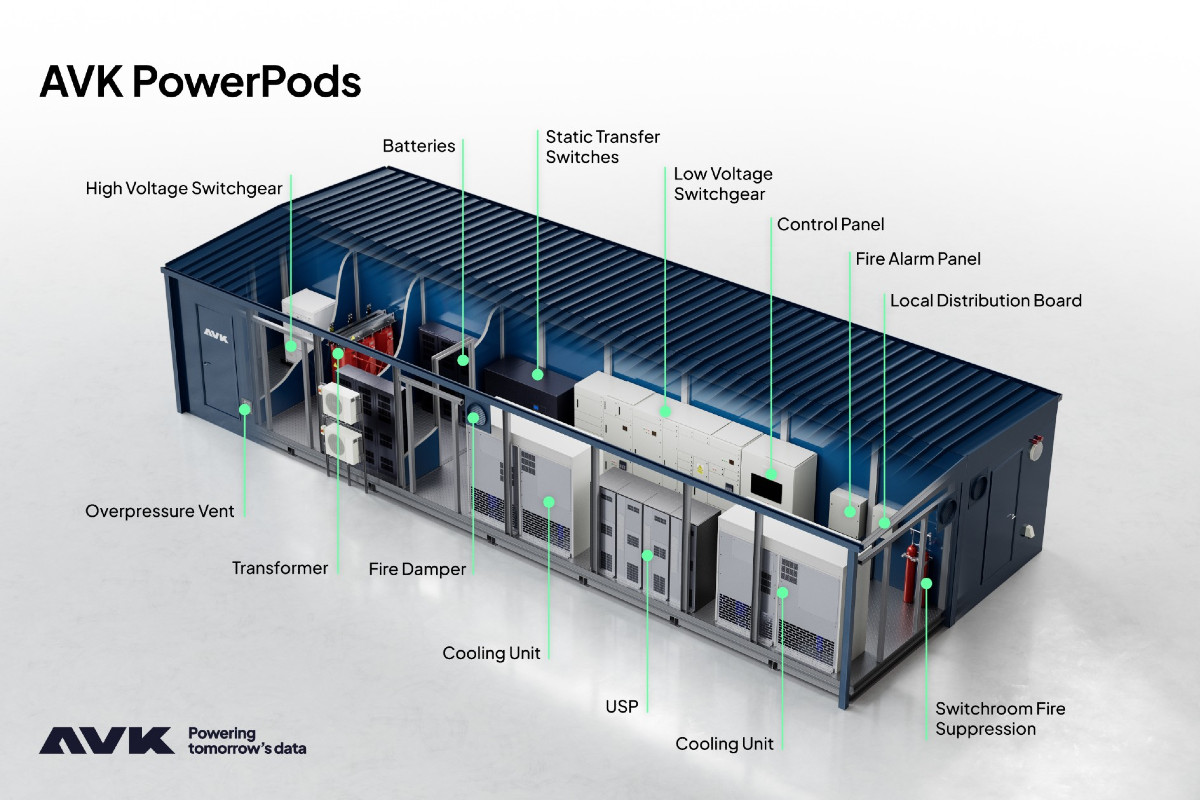
PowerPods take this approach and apply it across the full electrical room. Each unit consolidates transformers, switchgear, UPS, batteries, circuit breakers, cooling integration, control panels, fire suppression and distribution boards into one containerised solution. The operator receives a tested system rather than a collection of components waiting to be assembled, and the schedule risk that used to sit on the main contractor is absorbed by the supplier.
Inside Haydock
The scale of AVK’s investment in the model is visible in its 140,000 square foot Haydock facility, located in North-West England. Designed specifically to support hyperscale and AI infrastructure volumes, the site can house 22 to 25 PowerPods at any one time depending on configuration, with units up to 18 metres in length and 4.2 metres wide. Multiple access routes allow rapid dispatch across the UK and into Europe.
What matters about the facility is not just its size but what its size signals. PowerPods are productionised infrastructure, built for repeatable deployment at the pace AI operators require, not engineering exercises delivered one at a time. Customisation happens within each unit so operators retain control over the technology configuration that suits their specific facility, but the underlying manufacturing model is built for volume.
Single source, full power chain
One of the structural problems data centre operators have lived with for years is fragmented procurement across the power infrastructure. Generators come from one supplier, switchgear from another, UPS from a third, and integration risk lands on whoever is left holding the programme. AVK has spent more than 36 years building expertise across uninterruptible power supplies, standby power, prime power and control systems, and PowerPods now close the gap in that offering.
With the switchroom in place, AVK provides the entire power chain for a data centre, covering every part of the energy lifecycle through generation, distribution and ongoing service. A single design philosophy runs across the components, and accountability sits in one place rather than being spread across multiple vendors. For project directors managing complex programmes, that consolidation has real value.
Technology agnostic by design
PowerPods are deliberately designed to be technology-agnostic. Operators choose the best component for each function rather than accepting a bundled, single-vendor stack. AVK acts as an energy partner, consulting on the optimal configuration and sourcing equipment accordingly. The outcome is genuine flexibility, better lead times through a broader supply base, and a power infrastructure tailored to the operational profile of the facility.
This flexibility matters more in the AI context than in conventional cloud workloads. AI infrastructure has different thermal profiles, different load patterns and different redundancy requirements, and the right configuration for one operator will not suit another. A supplier-agnostic model accommodates that variation in a way that single-vendor solutions struggle to match.
A view from AVK
Ben Pritchard, CEO of AVK, noted, “The launch of AVK PowerPods reinforces our position as one of the few businesses capable of designing, delivering and supporting the entire data centre power ecosystem, at scale, with true flexibility and with the engineering depth that critical infrastructure demands. PowerPods complete our proposition to the market. With our ready-to-deploy model, we are perfectly positioned to support the next wave of hyperscale data centres and AI infrastructure.”
What this means for delivery
For data centre operators planning their next wave of capacity, the procurement conversation has changed. A credible single-source provider for the full power chain moves integration risk to the supplier, improves schedule certainty, and frees the operator to focus on the workload-facing decisions that actually differentiate their service. The hidden cost of multi-vendor power procurement has always lived in programme overruns and commissioning delays, and removing it has tangible value on the balance sheet.
The wider implication is that modular, factory-built power infrastructure has become a necessity for projects above a certain scale. AI has accelerated this transition because the alternative is no longer viable at the pace operators need to move. PowerPods are AVK’s answer to that shift, grounded in decades of critical power expertise and now sitting at the centre of how the next generation of hyperscale facilities will be powered.