
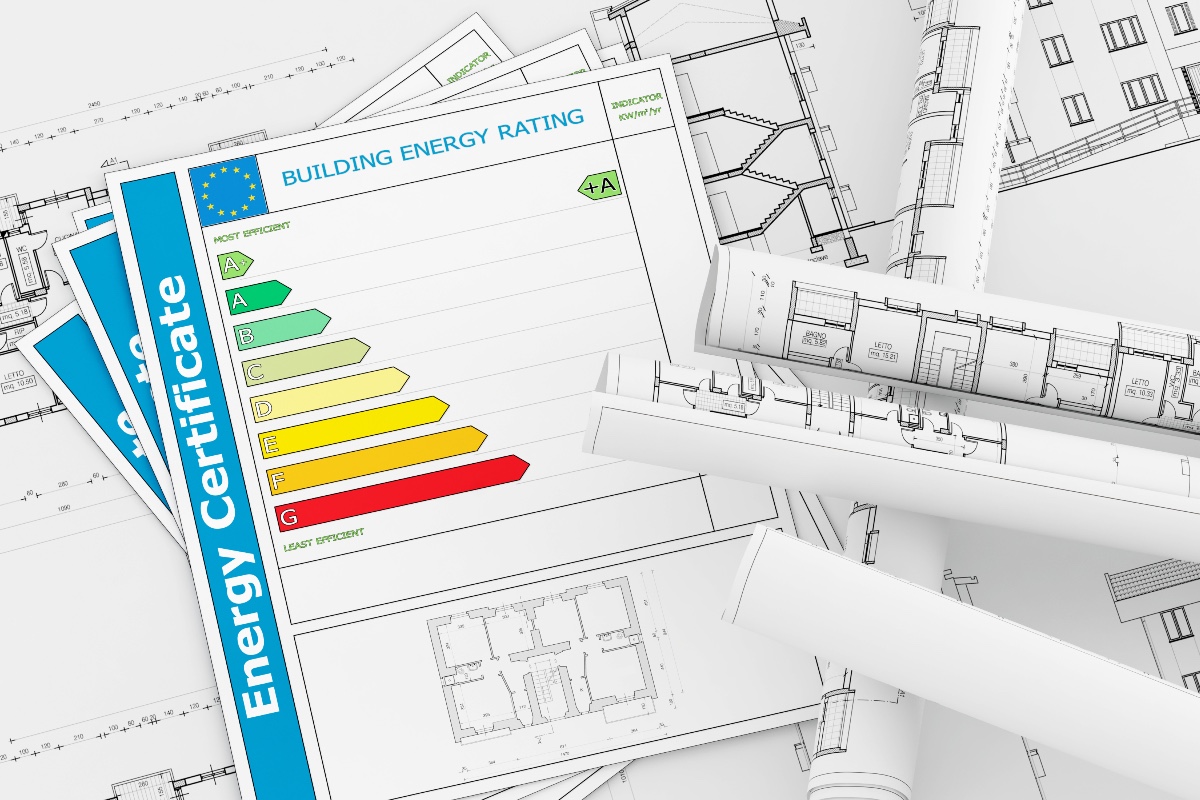
The European Commission has proposed an A-G sustainability rating system for data centres, while simultaneously beginning work on minimum performance standards that could introduce binding efficiency requirements across the EU.
Under the proposed scheme, individual data centres with at least 500kW of installed IT power demand would receive separate A-G ratings for power usage effectiveness (PUE) and water usage effectiveness (WUE).
An A rating would require PUE of 1.15 or below, while the equivalent threshold for WUE would be 0.1 or below. Meanwhile, facilities with PUE above 1.9 or WUE above 1.0 would receive a G.
The plan is for the labels to be generated using information operators already submit to the EU’s data centre reporting database, with the first labels given in August 2027 and then annually thereafter. But while it will initially just be that – labels – the EU is looking to move beyond simple transparency.
Alongside the rating system, the Commission has opened a 12-week consultation on minimum performance standards for data centres, with a legislative proposal planned for the second quarter of 2027.
The Commission describes minimum standards as the third stage of its approach, following mandatory reporting and the new rating scheme.
What will the EU data centre label show?
Alongside PUE and WUE ratings, labels would include information on the data centre’s size, location, commissioning date and energy mix. They would also show whether a facility provides flexibility services to the electricity grid and whether it is ready to reuse waste heat.
Water efficiency would also be considered alongside local conditions. Rather than receiving a separate rating for water stress, each label would be accompanied by Commission guidance explaining how WUE should be interpreted against factors including local water stress, climate, facility age and size, as well as the relationship between PUE and WUE.
What will the minimum standards entail?
While the labelling of individual data centres won’t be much of a concern for data centre operators, the more consequential question is what happens when minimum standards come into force.
Well, right now, the Commission’s consultation on minimum performance standards is open until December 14 and will inform legislation planned for Q2 2027. The Commission stresses that the proposal’s content and timing remain subject to change, but that it has not set mandatory thresholds just yet.
However, it has already made clear that it is considering a variety of factors – with requirements covering energy efficiency, water consumption, waste-heat reuse, grid services and other sustainability criteria.
As currently proposed, the minimum standards would be there for new or retrofitted data centres, but the Commission’s accompanying report suggests existing facilities could also be forced to meet the new minimum standards. If it takes that approach, it notes that facilities would be given a period in which to comply – so the industry shouldn’t expect an overnight change.
The Commission is hoping that by introducing minimum standards it could ultimately phase out the least efficient technologies and practices – even if they are desired by data centre operators on cost grounds.
It has reasons to push for more efficient data centres too. In its 2024 data collection period, EU data centres averaged a PUE of 1.36, while WUE was 0.58. That, according to the Commission, means that roughly half of reporting data centres exceeded a recommended PUE baseline of 1.5 and/or a recommended WUE baseline of 0.4, pointing to what it considers significant scope for further efficiency improvements.
Waste-heat reuse also remains limited. Just 67 reporting facilities recorded some heat reuse, with the Commission estimates that around 1.8% of the heat generated by reporting data centres was being reused.
Spain has already proposed strict minimum standards
Some Member States are already considering tougher requirements.
Spain has proposed new rules for data centres seeking grid access that would require qualifying facilities to meet the equivalent of the EU’s class A thresholds, with maximum PUE of 1.15 and WUE of 0.1.
The Spanish proposal would principally apply to data centres seeking at least 1MW of grid-access capacity. It would also require qualifying facilities to cover 80% of total electricity consumption with additional renewable generation and ensure at least 80% of electricity consumed in each hour is matched by renewable generation produced during that same hour.
The Spanish rules remain a draft following a public consultation that closed on September 10, but they show how the EU’s common performance classes could feed directly into national requirements.
That matters because Europe is simultaneously trying to build substantially more data centre capacity.
The Commission says the EU is looking to triple its data centre capacity over the next five to seven years, while its own modelling suggests supply could struggle to keep pace with demand.
Under the central scenario in the impact assessment for the proposed Cloud and AI Development Act, EU data centre demand reaches around 61.5GW of IT load by 2036, compared with around 42.5GW of installed supply.
European Central Bank President Christine Lagarde recently highlighted the resulting 19GW gap as she argued that Europe needs to accelerate infrastructure development if it is to support its AI ambitions.
Brussels is therefore trying to accelerate infrastructure development while tightening expectations around how that capacity uses energy and water.
The proposed rating scheme establishes a common way of measuring that performance, but with minimum standards, it could potentially make it even more difficult for data centre operators to further invest in capacity in the European Union.