


Lizzy McDowell, Director of Marketing at Kao Data, on why resilience has become the silent currency of women in digital infrastructure, and why the industry needs to stop celebrating it as a virtue and start asking what it costs.
There is a word that comes up in almost every conversation I have with women in this industry. It does not appear on a CV, it is not something anyone hands you at induction, and yet it shapes careers more than any qualification ever could. That word is resilience.
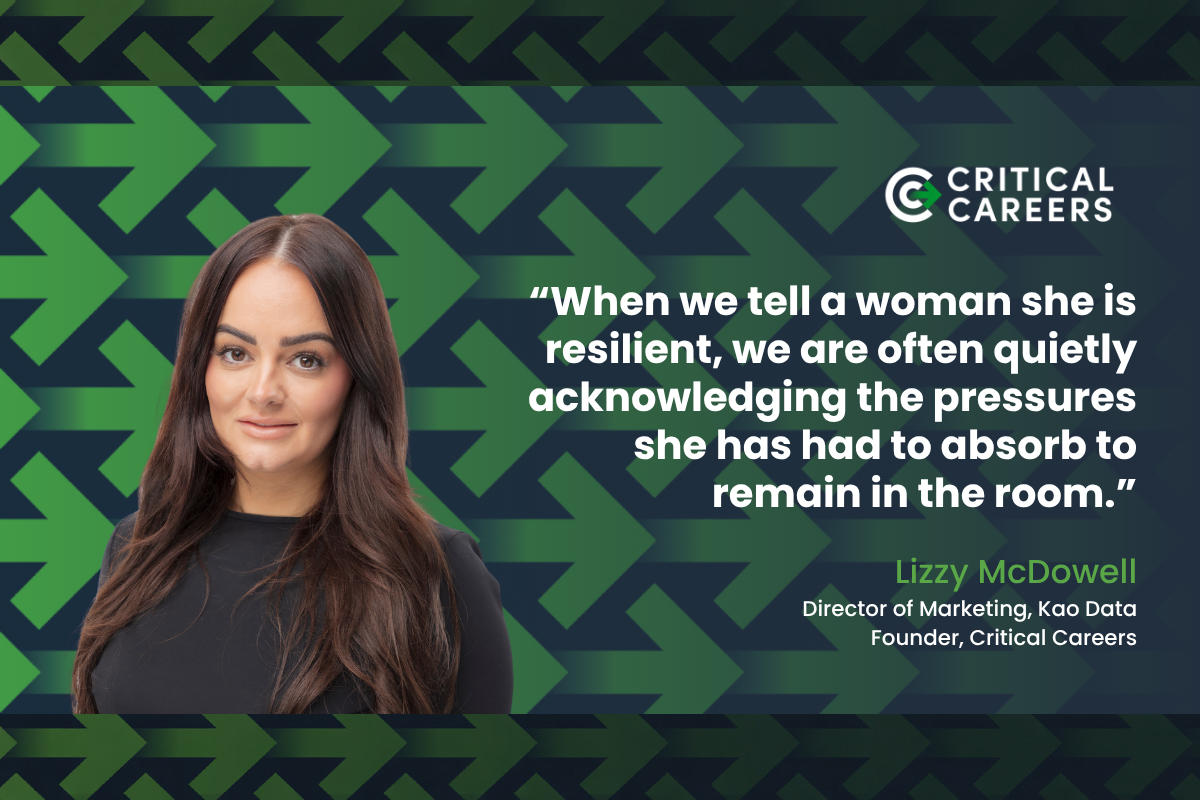
I have been thinking about it a lot lately. Resilience tends to be praised as a strength and rightly so. Careers in digital infrastructure are demanding, fast-moving and rarely follow a tidy path. But the more I listen, the more I notice something uncomfortable underneath the compliment. When we tell a woman she is resilient, we are often quietly acknowledging the pressures she has had to absorb to remain in the room.
Careers rarely follow a straight line
Joyce Wady, my brilliant colleague and author of our Critical Careers book, summed it up perfectly during our brainstorming session for this piece. She said careers rarely follow a straight line and the moments that shake your confidence, shift your direction and ultimately shape where you end up are the ones nobody puts on LinkedIn.
She is right. The senior leader who took on additional responsibilities without a change in title or renumeration. The engineer who took a sideways step to look after a parent then noticed her career trajectory stall. The young commercial manager who was the only woman in a meeting and had to repeat the same point three times before someone heard it. None of them describe these moments as defining. They describe them as part of the job.
That is what worries me. Resilience has become so normalised in our industry that we have stopped asking why women need quite so much of it.
The working mother problem we keep dancing around
Let me say what plenty of people already know, but few say out loud. One of the biggest tests of resilience for a women in digital infrastructure is becoming a mother. The hours are long, the projects are global and the culture in many businesses still equates visibility with commitment. When you add a young child or a caring responsibility to that mix, something has to give. Too often, what gives is the career.
Research published this April by Akamai found that 55 per cent of women leave tech roles within five years, and almost 90 per cent within ten, making the average career length for a woman in tech in the UK just six years. In an industry already short on female talent, that is not a personnel issue. It is a structural failure.
I have watched extraordinary women quietly step away from this sector because the cost of staying was too high. Not because they lacked the ability. Not because they lacked the ambition. Because the working pattern they were offered did not work for the life they were actually living. Calling that resilience is generous. Calling it a waste is closer to the truth.
Visibility at the top changes everything
The other piece of this is leadership. When younger women look up through the structure of a data centre operator, a consultancy or a contractor and see very few people who look like them at the top, the message lands without anyone needing to say it. The ceiling is not invisible. It is just politely not discussed.
Across these experiences though, certain patterns are clear. Where development is intentional, people are given the space to grow beyond their initial role. When career pathways are visible women can see what comes next and begin to move towards it with purpose. How leaders listen to and include different perspectives results in women feeling they don’t need to fight to be heard. Finally, when mentorship is part of how the industry operates, opportunities are more accessible and less dependent on timing or chance.
A Vodafone study I cited last month found that six in ten women would be more likely to apply for a role if they could see other women already in leadership positions. The same logic applies to staying. Women endure more when they can see a future version of themselves further up the path. Take that away, and resilience starts to look a lot like attrition in slow motion.
Resilience should not be a survival skill
I want to be very clear about something. The women I meet through Critical Careers are some of the sharpest, most determined, most generous professionals I have ever worked alongside. Their resilience is real and it is worth celebrating.
But resilience should be something they choose to draw on, not something the industry quietly relies on to keep its numbers afloat. The job of every operator, contractor and partner in this sector is to build workplaces where women do not have to be exceptional just to remain.
That means genuinely flexible working. Maternity returns that enable a smooth transition back into work, supporting both role continuity and work–life balance. And honest conversations at board level about why the women we admire so often describe their careers in the language of endurance.
Critical Careers will keep telling these stories because the more visible they become, the harder they are to ignore. Resilience built this industry’s female workforce. The next chapter has to be about what we build for them in return.
See you next month.