
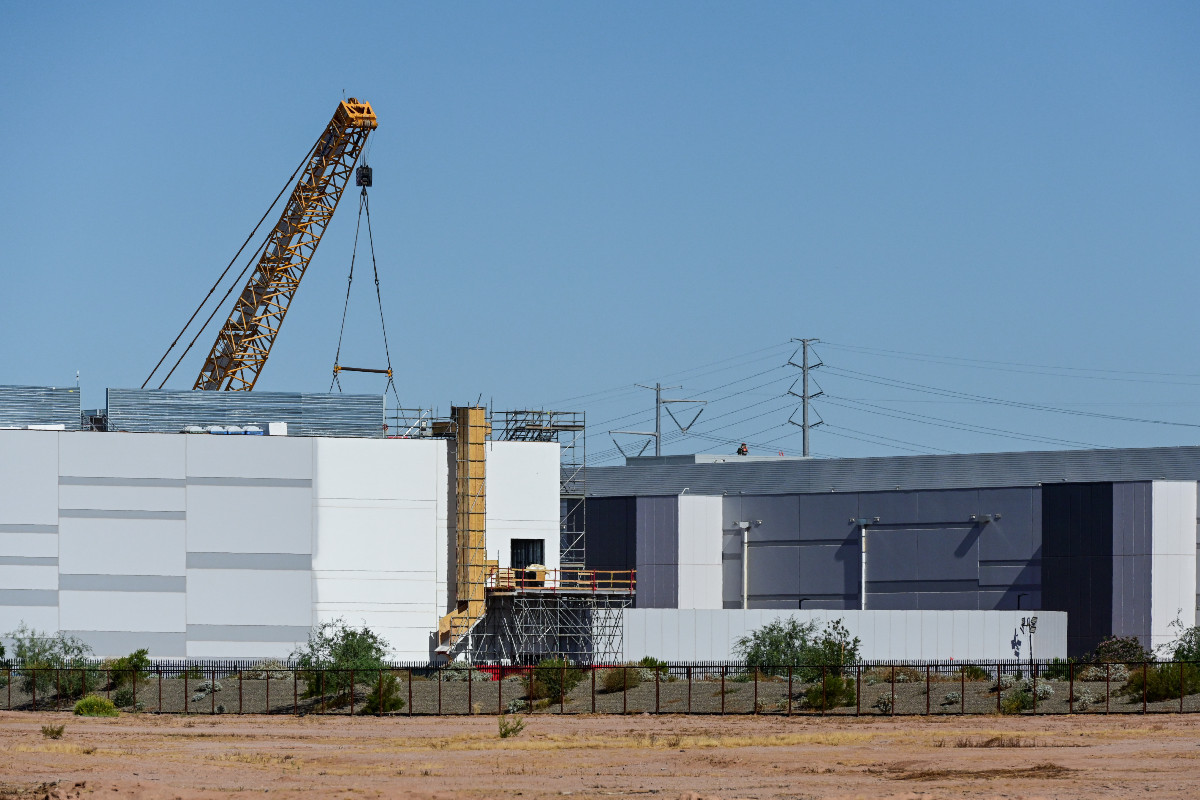
Balfour Beatty has ruled out expanding its data centre construction business into the UK or Europe, despite the AI boom driving a surge in new facilities across both markets.
The contractor is already benefiting from growing demand for data centres in the US, where increased activity across its buildings business helped push US Construction revenue up 19% to £2.48 billion during the first half of 2026. Balfour Beatty also secured around $350 million worth of new US data centre orders during the period.
However, Chief Executive Philip Hoare said the company had no plans to replicate that success on this side of the Atlantic, arguing that the margins available on UK and European data centre projects simply were not attractive enough.
He noted of the industry in the UK and Europe that, “It’s quite competitive and I’m not keen on entering into low margins.”
That is despite Balfour Beatty having extensive experience in the sector. In the US, the company has worked on hyperscale data centres for years, including more than 20 facilities across six campuses for one client since 2014.
Hoare indicated that the contractor is instead looking to expand its data centre footprint beyond its traditional markets in the north-west of the US, as demand for AI infrastructure continues to spread across the country.
Plenty of UK demand, but not at any price
Balfour Beatty’s reluctance to enter the UK market is particularly notable given the amount of money currently being poured into new data centre capacity.
CBRE expects another 180 MW of data centre supply to be delivered around London during 2026, which would make it the second-highest year on record after the 193 MW added in 2025. Demand is expected to remain even stronger, with take-up forecast to reach 189 MW this year and exceed new supply for the fifth consecutive year.
The UK Government is also actively trying to encourage further construction through its AI Growth Zones programme, which is designed to tackle some of the biggest barriers facing new developments, including slow planning decisions and lengthy grid connection queues. The Government believes the programme could ultimately unlock up to £100 billion of additional investment, although whether it continues under Burnham’s premiership is still anyone’s guess.
It’s a similar story across Europe, where the European Data Centre Association expects IT power demand to grow at a compound annual rate of 17% through to 2031, driven in large part by cloud computing and AI.
Yet Balfour Beatty’s position highlights an important distinction between a market having plenty of demand and that work necessarily being attractive to contractors. With increasingly large and technically complex AI facilities being proposed across Europe, competition between construction firms appears to be keeping pressure on margins despite the scale of investment.
For Balfour Beatty, there currently appears to be more attractive work elsewhere.
The company has identified UK energy, transport and defence alongside US buildings as its four main growth markets, with the expansion of Britain’s electricity network proving particularly lucrative. It recently secured a £325 million contract for the Netherton Hub transmission project in Aberdeenshire as part of the wider upgrade of the UK grid.
That combination of UK power work and US construction helped Balfour Beatty increase revenue to £5.56 billion during the first half of the year, up from £5.15 billion in the same period of 2025. Pre-tax profit was broadly flat at £129 million, compared with £132 million a year earlier, while its order book increased to £22.9 billion.
The strong start has prompted Balfour Beatty to upgrade its outlook for the full year, with the company now expecting a low double digit percentage increase in profit from its earnings-based businesses – slightly ahead of its previous guidance.
For now, though, it appears that none of that additional growth will come from building Britain’s AI infrastructure. Unless margins improve, Balfour Beatty seems content to leave the UK and European data centre boom to its competitors.
Those margins could improve in the coming years, however, as the AI boom continues to put a strain on the construction skills that are needed to deliver new data centres.