


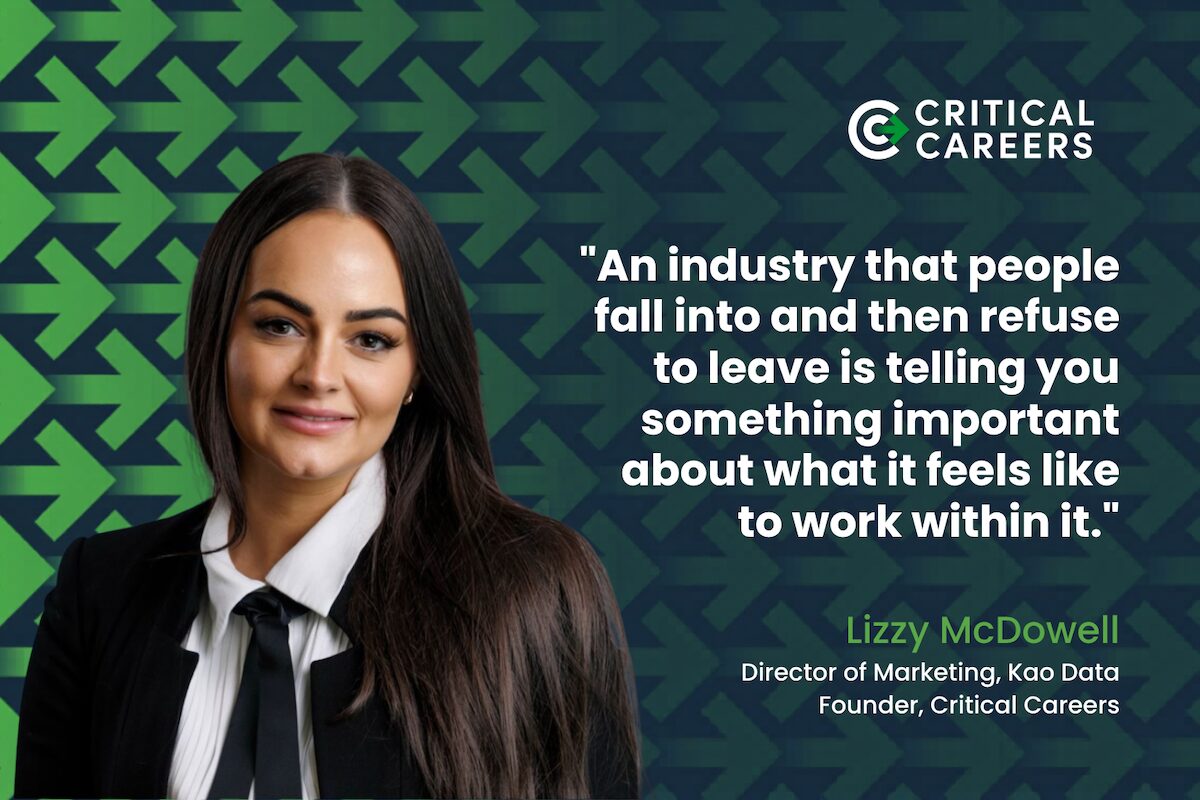
Lizzy McDowell, Director of Marketing at Kao Data, explores why so many people stumble into digital infrastructure by accident, only to discover an industry with a powerful reason to stay.
I wanted to be an actress. That was the plan, held with complete conviction, and there was nothing about that ambition that included critical national infrastructure. Nobody sat me down at school and explained that somewhere behind every audition tape I uploaded, every film I streamed and every drama school application I emailed, there was a building full of servers but, most notably, people underpinning each of these digital interactions.
However, the more people I tell about my career journey, the more I realise my rather random route into the world of digital infrastructure isn’t unique. I found this industry totally by accident, in my thirties, from a role adjacent to it. For a long time, I thought that made my story unusual. Having now spent over two years interviewing women across this sector for Critical Careers, I can tell you it makes my story completely archetypal.
Nobody wakes up wanting to work in a data centre
It’s the single thread running through every conversation we have recorded and documented. The women in our book came in from hospitality, from teaching, from the armed forces, from law, from the trades. Very few of them could point to a moment when they decided this was the career they wanted. Almost all of them can point to the moment they realised they were staying.
When I say that to people outside the sector, they tend to interpret it as a criticism of the sector. I have come to see it as the most revealing thing about us. An industry that people fall into and then refuse to leave is telling you something important about what it feels like to work within it. I believe it’s worth understanding why, rather than treating it as a happy accident.
I also think coming from the outside was useful. I arrived knowing very little, which meant I could see how the sector looked to everyone else. It’s easy, once you are three years in, to forget that most people have no idea what a data centre is, let alone that a career could be built inside one. That gap is where our talent shortage actually lives.
The difference between a job you enjoy and a job that means something
Here is what I have come to believe. If you chase a job that only makes you happy, or a job that makes you money, satisfaction will keep moving further away from you. Both are moving targets, and both depend heavily on a good week.
Having a deeper sense of purpose requires you to think and feel differently. It works more like a lighthouse. It does not remove the storm; it simply gives you something fixed to steer by while the weather does what it wants. The women I meet who have built long, deliberate careers in this sector are rarely the ones who found the easiest path. They are the ones who knew their why and how their work mattered.
That is the reason I named our initiative Critical Careers rather than anything softer. Criticality is the point. When the building you help design, power, secure or promote is the reason a hospital can access records, a bank can settle payments and a medical research institute can run its models, the value of your Tuesday afternoon is not really in question. You may have arrived with your own ambitions, and almost all of us did, but you end up inside something considerably larger than yourself.
I find that genuinely rare. Plenty of industries offer interesting work. Fewer offer work that would visibly break the world if everybody stopped doing it tomorrow.
The route in matters less than we think
If purpose is what keeps people here, visibility is what gets them through the door, and this is where I think we still make things unnecessarily hard for ourselves.
We tend to profile our industry from the top down. Lists of senior leaders, board appointments and keynote speakers all have their place, and I have benefited from that kind of recognition myself. The difficulty is that a hierarchy is quite a difficult thing for an eighteen-year-old to see herself inside. If the only people you can find are twenty-five years ahead of you, the message you take away is that this industry belongs to somebody else.
Critical Careers began life as a coffee table book precisely because we wanted the opposite effect. We wanted a shift technician, a project manager, a planner, a commercial lead or a marketer sitting alongside each other, at every stage of their careers, so that whoever picked it up could find someone recognisable.
Libby Milne, a Project manager at Buro Four, told us that what first drew her in was her dad taking her onto a construction site. It was not a careers leaflet. It was seeing the thing with her own eyes and thinking she could do that.
There is no typical day in this sector and no typical person doing it. You can work on the tools or in the boardroom, and the honest truth is that the industry needs both far more urgently than it needs another list of the already established.
Purpose is a retention strategy
I want to be practical about this, because purpose can sound like a soft idea in an industry that measures everything in megawatts and delivery dates. The build-out ahead of us is enormous and the talent gap is widening. Women still only make up around 8% of data centre teams, a figure Uptime Institute has watched barely move since it began collecting the data in 2018, and research from Akamai found that almost 90% of women leave tech roles within a decade. We cannot recruit our way out of that if the people we attract never understand what they are part of.
So it’s worth saying the purpose out loud. Put it in the job advert rather than leaving it to be discovered somewhere around month eight. Explain it properly at induction. Tell a new starter in accounts payable that the invoices she is processing belong to a building that keeps a health service running. People stay when they understand what they are contributing to, and the criticality of what we do is the most compelling recruitment argument we have. We just tend to keep it to ourselves.
None of this requires a personality change from our industry. It requires us to be a little less modest about why the work matters.
The plan I had at eighteen bears no resemblance to the career I ended up with, and I would not swap it. Critical Careers will keep telling these stories because somewhere there is a young woman who has never heard of digital infrastructure and who will one day help build it.
See you next month.