
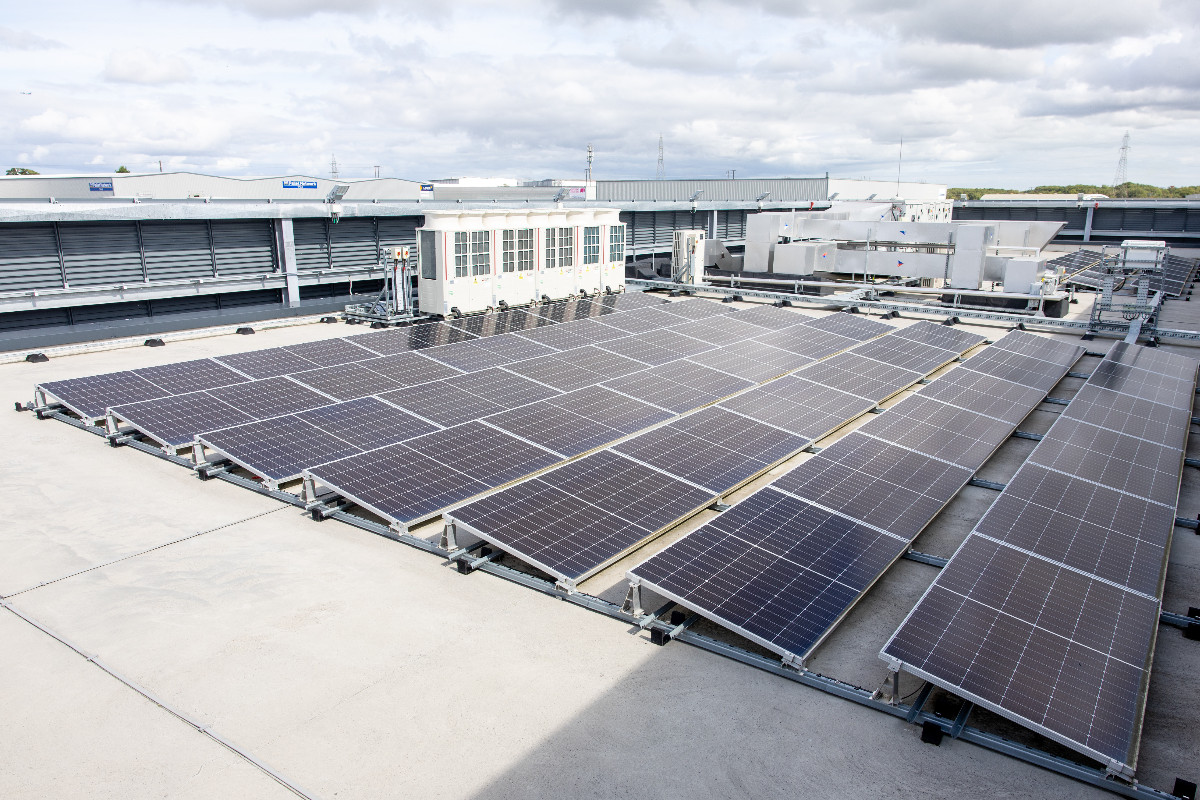
Pure DC and AVK have announced Europe’s ‘first’ data centre microgrid, and while some may argue over the very definition of what a ‘microgrid’ is and whether this is actually the first, there’s something far more important at play.
That’s because this 110MW privately-powered campus, designed to reduce dependence on delayed grid connections, is a sign that there may actually be an answer to the industry’s constant source of frustration – getting access to power.
For years, the European data centre market was shaped mainly by land, fibre, tax and proximity to customers. Those factors still matter, but as we all know, they’re no longer the dealbreakers when it comes to building a new data centre. The bottleneck now is time to power: how quickly a developer can secure large, reliable volumes of electricity in markets where grid reinforcement is slow and demand is rising fast.
That’s why this project matters. It proves that developers will increasingly stop waiting for the grid and start building around it.
Why Dublin?
Ireland is the clearest place to see why this shift is happening. Official figures show that data centres accounted for 22% of the country’s metered electricity consumption in 2024, up from 5% in 2015. Sector consumption rose to 6,969 GWh last year. In a small economy, that is no longer a niche infrastructure issue. It is a system-level challenge.
The policy response has been equally revealing. In December 2025, Ireland’s regulator said new data centres seeking electricity connections would be required to provide generation and/or storage capacity, either on-site or nearby, to match their requested import demand. They must also meet at least 80% of annual demand with additional renewable electricity projects in Ireland, with a six-year glide path for those projects to come online. Ireland is, in effect, telling developers that large digital loads can no longer arrive as passive consumers of scarce public infrastructure.
That makes Dublin less an outlier than a laboratory. The Pure DC scheme is best understood not as a quirky local workaround, but as a response to a new market reality. If public-grid capacity cannot be delivered quickly enough, then campuses will increasingly be designed as partial energy systems in their own right, combining generation, storage and more flexible interaction with the wider network.
A continental constraint
What is happening in Ireland matters because the underlying problem is European. The International Energy Agency says Europe’s share of global data centre capacity has fallen from more than 25% in 2015 to 15% in 2024, even as the European Commission wants to triple EU data centre capacity within five to seven years. At the same time, the IEA says data centres are set to account for 10% of EU electricity-demand growth by 2030 under current policies. Europe wants much more compute while its electricity system is already being stretched by electrification, industrial policy and decarbonisation.
The issue is not simply how much electricity Europe can generate, but how slowly it can deliver that power to the places where developers want to build. The IEA says grid connection waits in the EU range from two to ten years, with queues of seven to 10 years in the main FLAP-D hubs. The situation is even worse in the UK, with the Department for Energy Security and Net Zero forced to step in after the connections queue grew by 460% in the six months to June 2025, driven by speculative applications, prompting reforms aimed at prioritising strategically important projects such as AI data centres.
That is the deeper significance of Dublin’s microgrid. It points to a change in the economics of the sector. Data centre development is becoming less a pure real-estate and connectivity business and more an energy business. The competitive edge will increasingly belong to jurisdictions that can align land, permits, substations, generation and storage into one credible package. In that sense, grids are no longer just utility infrastructure. They are instruments of industrial competition.
AI meets physical reality
This is why Europe’s debate about AI is becoming inseparable from its debate about energy. It is easy to talk about models, chips and sovereign compute. It is harder to confront the fact that large-scale AI infrastructure depends on slower-moving systems: transmission lines, local planning approvals, backup generation, storage and market rules. Dublin’s new project is a reminder that the limiting factor in Europe’s digital expansion is increasingly not demand for compute, but access to dependable power.
The consequence is that investment will increasingly flow to places that can make electricity available at scale and on time. While the hyperscalers, colocation providers and data centre operators would love to build more data centres in regions, like the UK and Europe, they have to be realistic and go where the power is. Countries that can offer that available power will be using that to their advantage.
We are already seeing Gulf states, especially Saudi Arabia, the UAE and Qatar, pitch themselves as AI hub locations, backed by large data-centre plans and relatively cheap power.
That’s why microgrids are an interesting proposition. It allows data centre developers to continue developing in the regions where they’re seeing the biggest growth in AI – such as in FLAP-D or in the US.
The climate bargain
There is, however, an obvious tension at the centre of this model. Europe is not only trying to build more data centres; it is trying to build cleaner ones. The European Commission’s digital strategy sets a goal of climate-neutral, highly energy-efficient and sustainable data centres by 2030, and it is exploring further measures to improve energy efficiency, heat reuse and the broader sustainability of cloud and data-centre infrastructure.
That means microgrids will not be judged simply on whether they accelerate deployment. They will be judged on what fuels they rely on, how long they rely on them, whether storage is meaningfully integrated, whether renewable supply is genuinely additional, and whether heat and water are managed more intelligently than in conventional designs. On-site generation may solve a speed problem and a resilience problem. It does not automatically solve a carbon problem.
That is what makes Ireland’s approach so important. It is trying to force a bargain: bring your own flexibility, but also bring cleaner supply. That may prove difficult in practice, especially if gas-backed systems remain in place longer than promised. But it is a more realistic response than pretending Europe can rapidly expand AI and cloud infrastructure while leaving electricity systems to catch up on their own timetable.
Dublin’s microgrid matters, then, not because it settles a marketing argument about who was first, but because it shows where Europe is heading. The continent’s digital expansion is no longer constrained chiefly by demand for compute. It is constrained by access to power. In the next phase of Europe’s AI buildout, the winners will not simply be the markets with the deepest fibre networks or the largest cloud clusters, but the ones that can turn electricity, permitting and decarbonisation into a coherent industrial strategy.