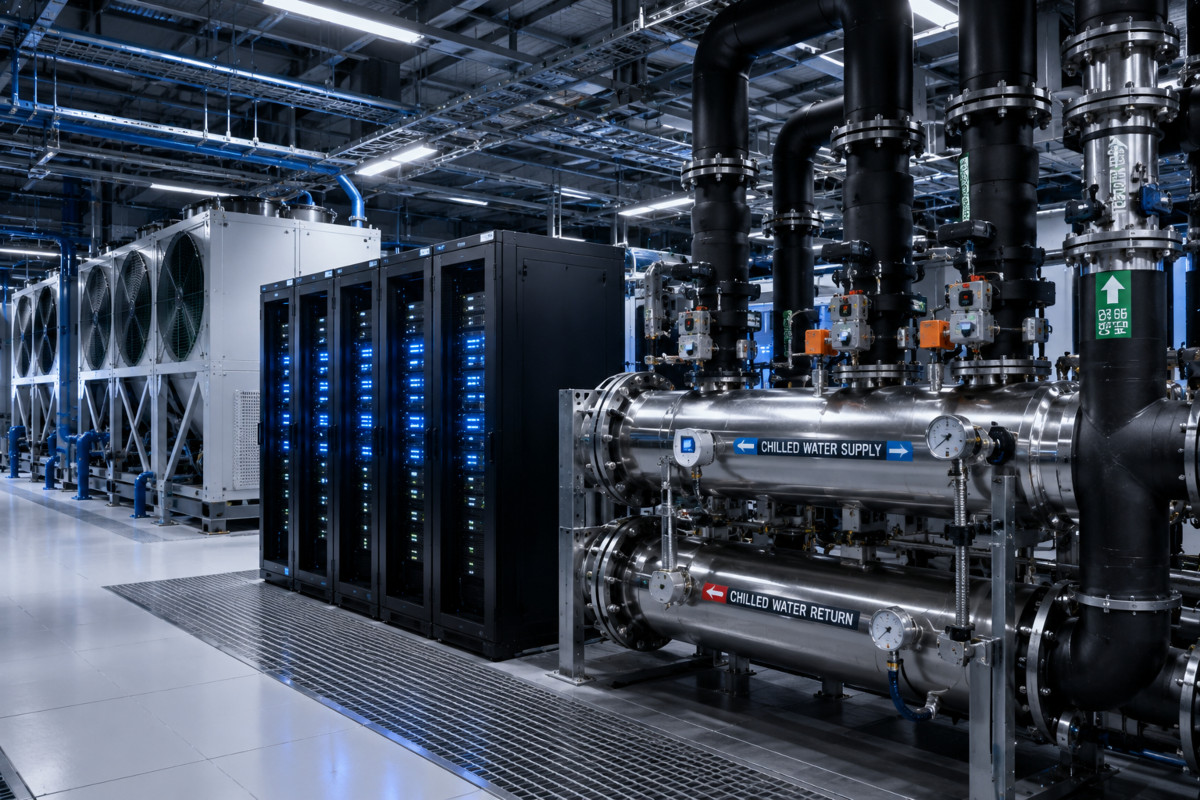
As direct-to-chip liquid cooling becomes a foundational technology for high-density computing environments, much of the industry’s focus remains on operational performance – coolant chemistry, thermal transfer efficiency and long-term system reliability. But before any of those factors can be optimised, one essential step determines whether a cooling system starts strong: pipework preparation.
Pre-commissioning cleaning is one of the most important – and often underestimated – parts of liquid cooling system start-up. Done correctly, it removes debris, corrosion by-products and contaminants introduced during fabrication and installation before they can compromise sensitive cooling components. Done poorly, those materials can migrate into narrow channels, reduce heat transfer performance and create avoidable commissioning challenges from day one.
For direct-to-chip systems, where cooling loops contain increasingly small passages and precision-engineered components, cleanliness is not optional – it is operationally critical.
Why standardisation matters
Unlike traditional cooling infrastructure, liquid-cooled rack systems are highly customised. System architecture, loop configuration and facility requirements can vary significantly from one deployment to the next. That variability has made it difficult for the industry to establish a consistent approach to pre-commissioning pipework cleaning.
To help close that gap, Ecolab cooling management experts co-developed comprehensive pre-commissioning specifications designed to guide teams through pipework preparation before connecting liquid-cooled racks to coolant distribution units (CDUs).
Developed in alignment with the Open Compute Project’s five core principles – openness, efficiency, impact, scale and sustainability – the methodology provides a structured, scalable and environmentally conscious approach to preparing cooling loops for operation.
At its core, the process is built around two phases: planning and cleaning.
Phase one: Build the plan before the flush
Effective pipework cleaning begins well before water enters the system.
The planning phase is designed to ensure teams have the equipment, documentation and operational coordination required for a successful flush. This includes securing cleaning reagents, test kits, filtration equipment and temporary flushing components, as well as verifying that physical assets are properly installed and ready for preparation.
Cross-functional coordination is equally important. Teams must align flushing schedules with broader testing timelines, establish wastewater discharge plans with local authorities and isolate liquid-cooled racks from CDUs before cleaning begins.
Key planning priorities include:
- Developing a working piping and instrumentation diagram for hydrotesting and flushing configurations
- Determining the number of flushing skids required based on system size, available equipment and sequencing strategy
- Identifying temporary hoses, connectors, flanges and consumables needed during flushing
- Procuring laboratory and field equipment, including tools for pH monitoring, colorimetric analysis and fluid verification
- Installing temporary flushing equipment and assembling loopback configurations for circulation
Once these elements are in place, teams can move into active cleaning.
Phase two: Clean for performance
Before cleaning the pipework itself, flushing equipment must be verified and cleaned to remove impurities that could be introduced during circulation. Teams should also perform system checks to confirm hydraulic performance and identify leaks before pressure testing begins.
From there, the cleaning sequence typically includes:
Pre-hydrostatic verification – Circulate procedure water through pumps, pipes, hoses and filters to validate hydraulics and establish baseline equipment cleanliness.
Hydrostatic testing – Pressure-test the system at approximately 1.3× to 1.5× operating pressure and correct leaks before proceeding.
Chemical cleaning and recirculation – Introduce cleaning chemistry, circulate it through the rack piping loop and follow a controlled recirculate-clean-drain sequence to remove contaminants.
System flushing – Thoroughly rinse the system to remove residual cleaning chemistry ahead of start-up.
Commissioning preparation – Immediately charge the cleaned system with glycol coolant to minimise contamination risk after flushing.
Each step builds on the last, creating a cleaner, more stable operating environment before the system ever supports live workloads.
A better commissioning outcome starts upstream
Pre-commissioning cleaning is not simply a start-up task – it is foundational risk management.
A standardised, disciplined cleaning process helps ensure liquid-cooled racks begin operation with unobstructed flow paths, cleaner internal surfaces and optimal conditions for heat transfer. That reduces commissioning friction, supports system reliability and drives stronger cooling performance over time.
As liquid cooling adoption accelerates, operators who treat pipework preparation as a critical engineering discipline – not a procedural checkbox – will be better positioned to maximise performance from day one.
Ecolab is a world leader in water management, cooling and treatment solutions. Learn how to outsource your pre-commissioning liquid-cooled rack cleaning to the Ecolab team by visiting our website.