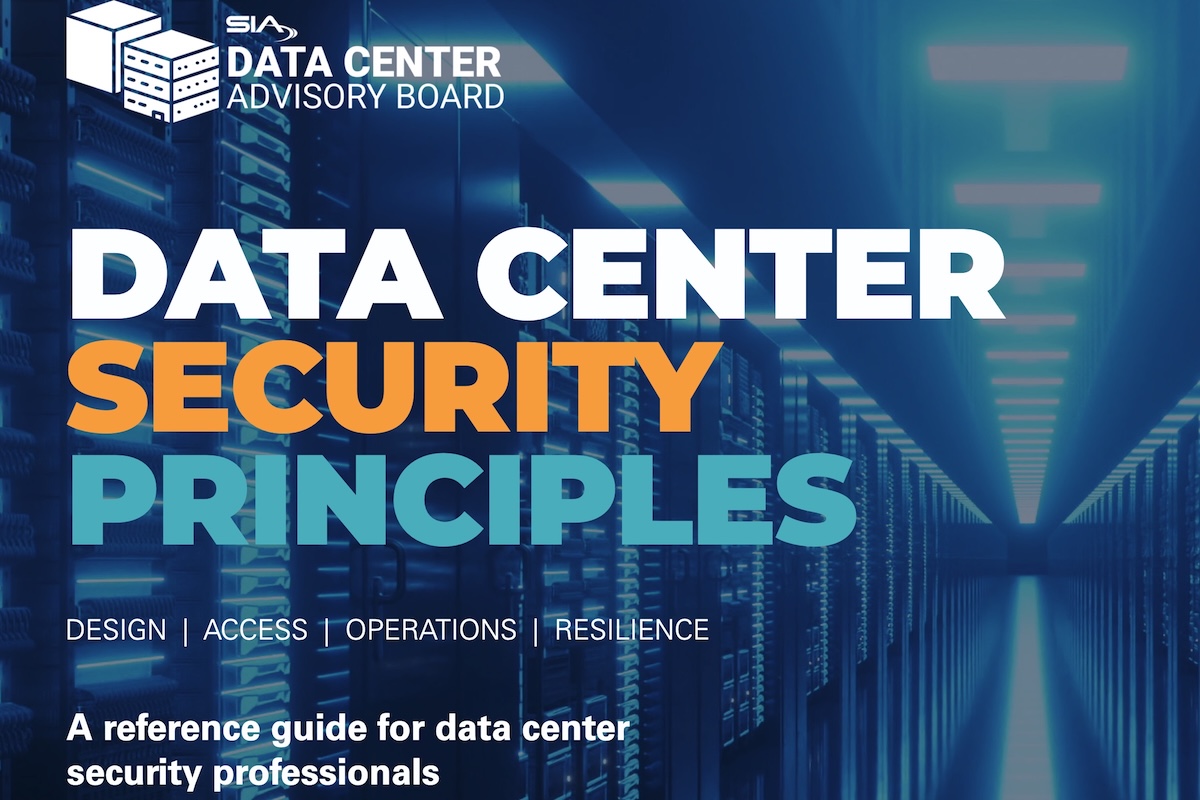
The Security Industry Association has published a new reference guide for data centre security, setting out 12 principles designed to help operators strengthen physical security across critical environments.
The guide, titled Data Center Security Principles: A reference guide for data center security professionals, has been produced by the SIA’s Data Center Advisory Board, which was established to support data centre security through collaboration, industry leadership and policy engagement.
While it has set out 12 key principles, the SIA is key to stress that it’s not designed as a detailed technical rulebook. Instead, the 12 principles are meant to be high-level, acting as a foundation for the Advisory Board’s future work on physical security best practice for data centres.
Those 12 principles are split across four key areas: design and architecture, access and trust, operations and management, and resilience and adaptability.
Under design and architecture, the guide calls for security stakeholders to be involved before land is acquired or leases are signed, rather than being brought in once key decisions have already been made. It also stresses the importance of security being built into projects from the outset, alongside defence in depth and secure-by-default approaches.
That early involvement could prove particularly important for data centre developers, given the sector is already facing pressure around planning, grid connections and site selection. It notes that if physical security requirements are only considered late in the process, operators could find themselves relying on expensive compensating measures that may have been avoidable at the design stage.
The guide also highlights the importance of least privilege, proportionate security friction and zero trust. In practice, that means limiting physical and logical access to only what is required, while ensuring security controls do not create unnecessary operational barriers.
That balance is likely to be important for operators. Data centres need robust security, but they also need to function as highly controlled operational environments where engineers, contractors and customers may all need access to different areas at different times. Too little friction creates risk, but too much can slow down essential work.
The final sections of the guide focus on secure operations, streamlining, risk-based controls, resilience and adaptability. The SIA says security controls and monitoring should be continuously improved to keep pace with evolving threats, while default credentials should be removed and replaced with stronger controls.
It also argues that data centre operators should simplify systems where possible, with fewer vendors, fewer technologies and fewer product models helping to reduce potential points of failure and make updates easier to manage.
Resilience is also central to the guidance, with the SIA calling for redundancy across physical and logical networks, backup power sources, multiple independent utility feeds and near-immediate fallback plans for disaster recovery scenarios.
While many of the principles will already be familiar to experienced operators, the publication of a common reference point could help bring greater consistency to how physical security is considered across the data centre sector.
That will become increasingly important as facilities grow in scale, complexity and criticality. While data centres have traditionally taken cybersecurity very seriously, physical security is not talked about as often – despite the fact that the industry is facing a very real threat.
This is especially prudent given the UK Government has already designated data centres as Critical National Infrastructure, reflecting the growing recognition that these facilities are no longer simply commercial assets, but essential infrastructure that many other sectors rely on.
You can read the full guide here.