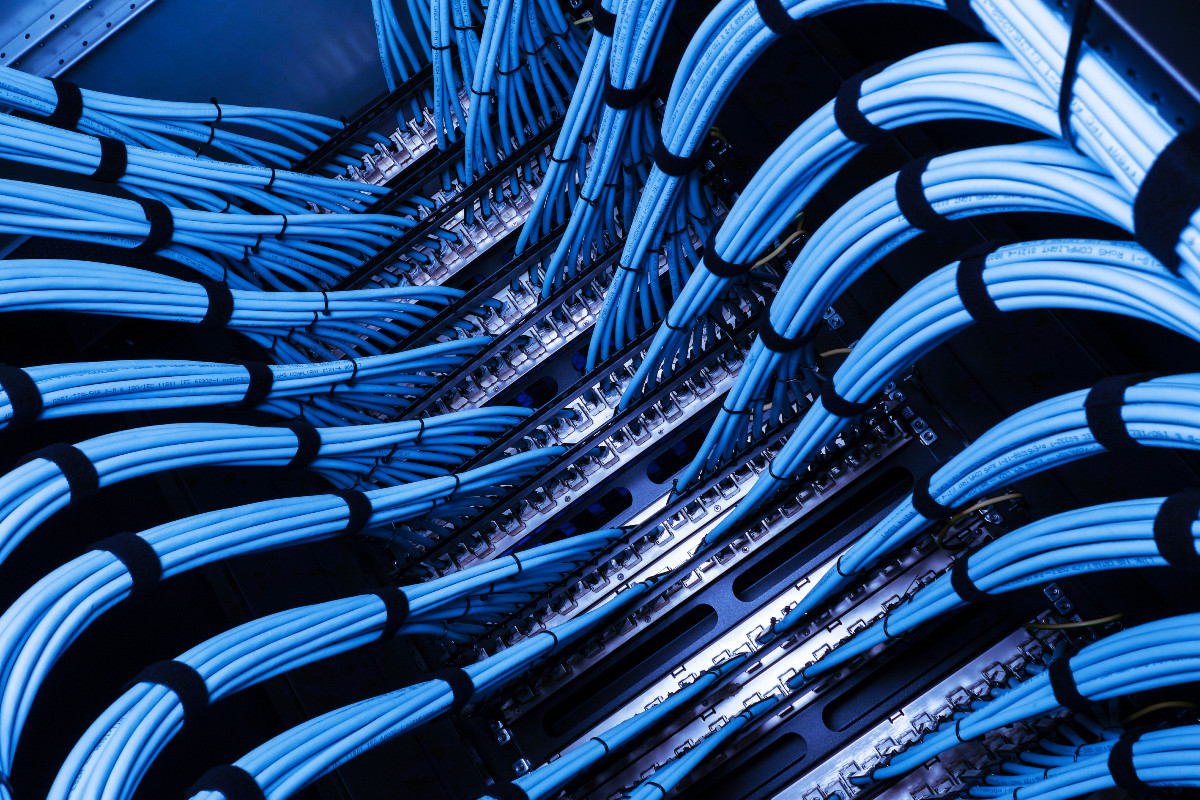
Data centres now account for more than 41% of all structured cabling installed globally, according to new research from BSRIA.
The organisation’s latest Structured Cabling Worldwide 2026 report, which covers 34 countries, found that the global structured cabling market grew 21% in 2025 to $9.08 billion, adding $1.3 billion in value in a single year. That followed growth of almost 11% in 2024.
The data centre segment was the main driver of that growth, increasing by 54% in 2025, as investment in AI infrastructure continued to push demand for cabling higher. That has helped reshape the market, with data centres now accounting for more than two in five cabling installations globally, almost double the 21% share recorded between 2015 and 2018.
It’s yet another sign of how quickly AI infrastructure investment is feeding through into the wider electrical and digital infrastructure supply chain. While much of the attention has been on power availability, grid connections and cooling, the growth of AI data centres is also having a significant impact on the cabling market.
Markets including Denmark, Spain, Switzerland, Germany and India all recorded strong growth, but the US remains the clear outlier.
The US delivered the strongest growth of any market, with sales up 44% year-on-year. It also accounted for 89% of the total global value increase in 2025, underlining just how concentrated the current wave of data centre cabling demand has become.
According to BSRIA, the US now holds 69% of the global data centre cabling market, making it 14 times the size of second-placed China. Germany, the UK, Australia and India follow as the next largest data centre markets.
That figure does come with a caveat, however. Some of the US total reflects products shipped from American hyperscalers into Canada, Latin America and Europe, meaning the headline number slightly overstates domestic installation. Even so, BSRIA notes that the gap between the US and the rest of the world has widened.
AI reshapes the cabling market
The growth in data centre cabling is also creating a split in the market. On one side is data centre work, which is increasingly dominated by large-scale, high-value projects and a relatively small group of suppliers. On the other is the LAN market, which continues to provide the underlying connectivity for commercial buildings, including desks, Wi-Fi and security systems.
LAN sales grew 2% in 2024 and 5% in 2025, as the market continued to recover from the supply chain disruption that followed the Covid-19 pandemic.
Regional performance varied, however. The Americas now hold almost half of the LAN market, at 45%, and grew 9% in 2025, driven by the US and Canada. Asia Pacific contracted by 1.9%, largely due to a 7% decline in China, which BSRIA linked to a 17% fall in non-residential construction.
India and Southeast Asia performed better, helping to offset some of that regional weakness.
Lone Hansen, Manager IT Cabling, BACS & Associated Technologies at BSRIA, commented, “The shape of this market has changed in a short space of time. Data centres are where most of the value growth is, and the US is pulling further ahead because of investment in AI infrastructure across all data centre segments. The LAN side of the market is doing the essential work of connecting offices, powering desks, supporting WLAN and keeping security systems running, and that demand is steady rather than spectacular.”
Copper demand remains resilient
Despite the growing role of fibre in high-capacity environments, copper cabling continues to hold its own, with Cat 6A now overtaking Cat 6 in global sales.
Hansen added, “Copper has held up better than people expected. LAN cabling is essential for connectivity and power to desks, Wi-Fi and security systems, and Cat 6A has now overtaken Cat 6 in global sales. Material cost rises in the second half of 2025 pushed prices up, which has shifted the commercial conversation as much as the technical one.”
China, meanwhile, appears to be taking a different route when it comes to AI data centre connectivity. According to BSRIA, Direct Attach Cables account for 90% to 95% of connections in Chinese AI data centres, largely because of their lower cost and shorter lead times.
That means structured cabling is playing a smaller role in Chinese AI builds than it is in the US and other regions, something suppliers may need to factor into their Asia Pacific strategies.